线性代数的本质 · 精研复习站

第 08-2 集:以线性变换的眼光看叉积

Cross products in the light of linear transformations
一句话直觉:把叉积看作从 $\mathbb{R}^3$ 映射到数轴的“有向体积”线性变换 $L(\vec{x})=\det([\vec{x}\;\vec{v}\;\vec{w}])$,其唯一对偶向量 $\vec{p}$ 在代数上等于伪行列式展开、在几何上恰好等于垂直底面且长度等于底面积的叉积向量。

本讲用《点积与对偶性》建立的核心武器,给出三维叉积“伪行列式计算法”与“几何定义”为何等价的完整证明。我们将已知两个三维向量 $\vec{v},\vec{w}$ 固定下来,将三阶行列式的第一列设为可变输入向量 $\vec{x}=(x,y,z)^T$,从而定义一个从三维空间到数轴的线性变换 $L(\vec{x})$;接着分别从代数计算与几何体积(底面积乘以垂直投影分量)两个独立角度求解 $L$ 的唯一对偶向量 $\vec{p}$——因为同一线性变换的对偶向量唯一,代数的“伪行列式”结果必然等同于满足面积长度、垂直法向与右手定则的几何叉积向量。

▶ YouTube 原片 📺 B站官方双语 P12 🎙 B站中文配音 P12

前置依赖

← 第 05 集 · 行列式:理解三阶行列式度量三维空间中平行六面体的有向体积,且其正负符号遵循右手定则。
← 第 07 集 · 点积与对偶性:掌握对偶性核心结论:任何 $\mathbb{R}^3\to\mathbb{R}$ 线性变换都唯一对应一个对偶向量 $\vec{p}$,使得 $L(\vec{x})=\vec{p}\cdot\vec{x}$。
← 第 08-1 集 · 叉积的标准介绍:了解三维叉积的几何性质(面积长度、垂直、右手定则)以及在矩阵第一列填入 $\hat{\imath},\hat{\jmath},\hat{k}$ 的伪行列式计算规则。

后续延伸

→ 第 08·拓展 集 · 克莱姆法则的几何解释:延续行列式度量面积/体积缩放的思想,用有向面积与有向体积的几何视角重新推导求解线性方程组的克莱姆法则。
→ 第 09 集 · 基变换:在完成乘积与对偶主题后,迈入下一阶段的核心——不同坐标系视角下的基变换与矩阵相似。
有向体积线性变换定义
$$L(\vec{x}) = \det\begin{bmatrix} x & v_1 & w_1 \\ y & v_2 & w_2 \\ z & v_3 & w_3 \end{bmatrix}$$
对偶向量定义方程
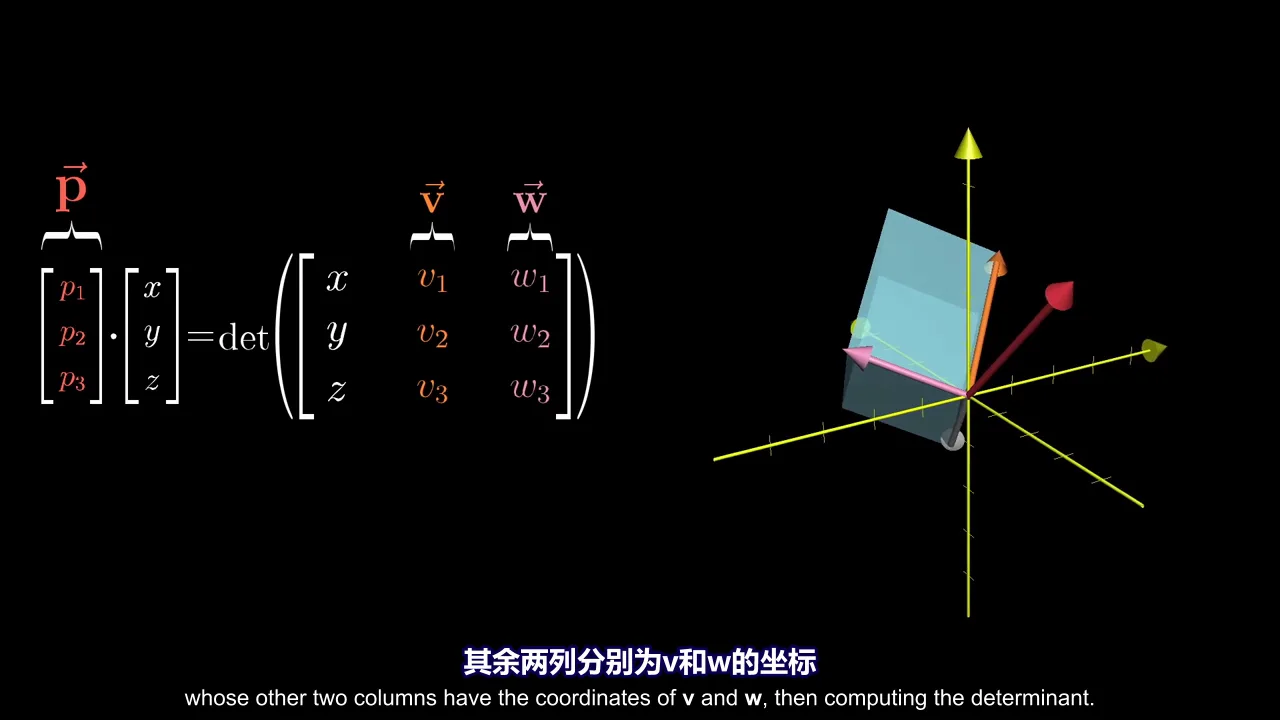
$$\vec{p}\cdot\begin{bmatrix} x \\ y \\ z \end{bmatrix} = \det\begin{bmatrix} x & v_1 & w_1 \\ y & v_2 & w_2 \\ z & v_3 & w_3 \end{bmatrix}$$
代数展开提取对偶向量坐标
$$p_1 x + p_2 y + p_3 z = (v_2 w_3 - v_3 w_2)x + (v_3 w_1 - v_1 w_3)y + (v_1 w_2 - v_2 w_1)z$$
几何体积分解等价式
$$\text{SignedVol}(\vec{x},\vec{v},\vec{w}) = \operatorname{Area}(\vec{v},\vec{w})\cdot (\text{Comp}_{\perp}\text{ of }\vec{x}) = \vec{p}\cdot\vec{x}$$

伪行列式技巧与对偶性回顾

⏱ 00:17 – 03:43

在上一讲中,我们见识了一个古怪的公式:把 $\hat{\imath}$、$\hat{\jmath}$、$\hat{k}$ 放进 $3\times 3$ 矩阵第一列,把 $\vec{v}$、$\vec{w}$ 放进二三列求行列式,得到的系数居然恰好构成满足“长度为平行四边形面积、同时垂直于两向量、方向服从右手定则”的唯一向量。相比死记硬背暴力代数验证,本讲用对偶性(Duality)给出一个直击灵魂的证明。

💡 快速重温对偶性武器
任何从多维空间映射到一维数轴的线性变换 $L:\mathbb{R}^3\to\mathbb{R}$,都能用一个仅有一行的 $1\times 3$ 矩阵表示;把这个行矩阵“立起来”转置成列向量,就得到该变换在原空间中唯一的对偶向量 $\vec{p}$,使得对任意输入向量施以变换,完全等价于与 $\vec{p}$ 做点积。

本讲的妙计是:专门围绕 $\vec{v}$ 和 $\vec{w}$ 构造一个特定的 $\mathbb{R}^3\to\mathbb{R}$ 线性变换,然后分别从“代数展开”和“几何体积”两条路径去寻找它的对偶向量——由于同一变换的对偶向量唯一,两条路径求出的向量必然是同一个!
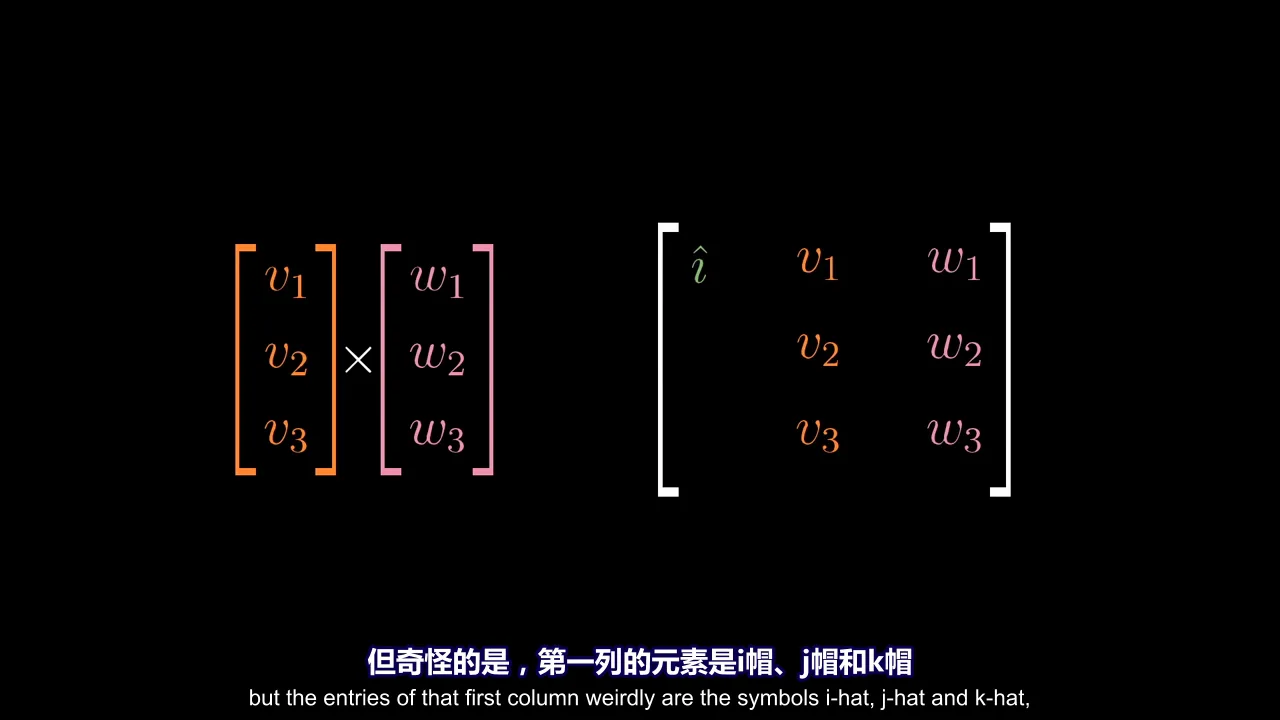
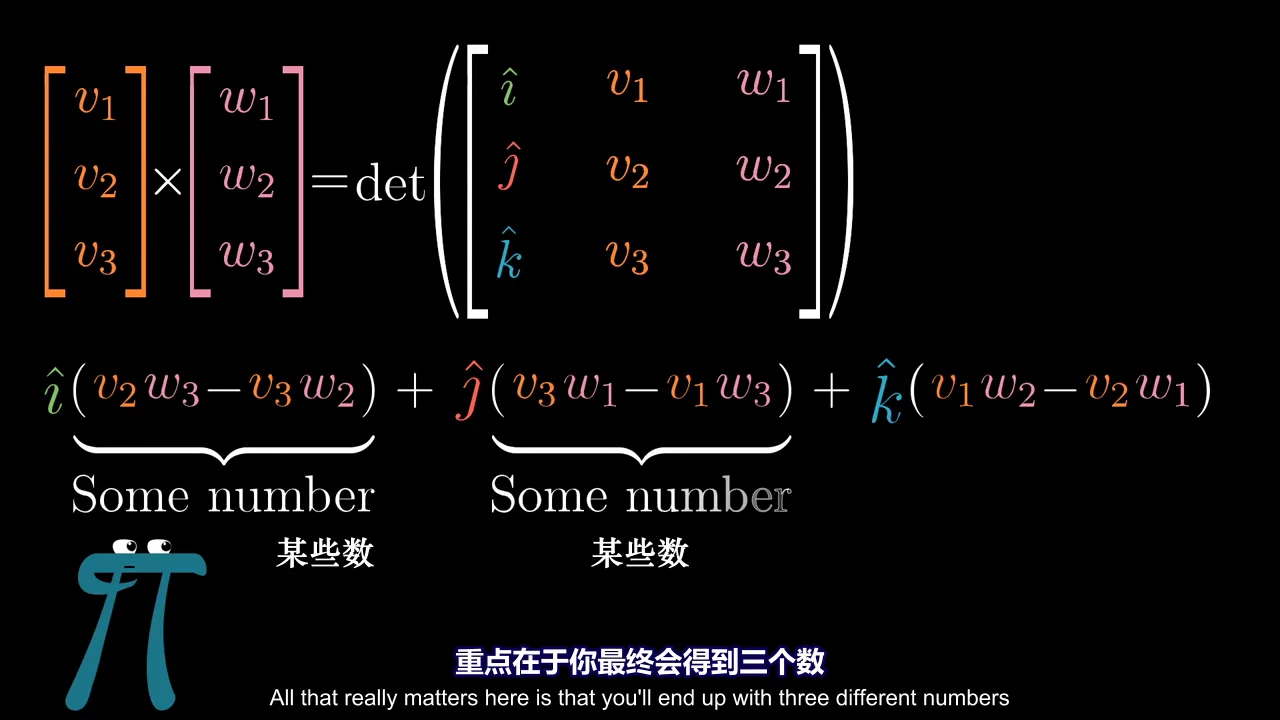
重温伪行列式设阵:第一列为符号基向量 $\hat{\imath},\hat{\jmath},\hat{k}$,二三列为 $\vec{v},\vec{w}$ 00:35
重温伪行列式设阵:第一列为符号基向量 $\hat{\imath},\hat{\jmath},\hat{k}$,二三列为 $\vec{v},\vec{w}$画面重点:含 $\hat{\imath},\hat{\jmath},\hat{k}$ 第一列的 $3\times 3$ 矩阵
展开伪行列式提取出三个实数系数,组合成新向量的坐标 01:08
展开伪行列式提取出三个实数系数,组合成新向量的坐标画面重点:$\hat{\imath},\hat{\jmath},\hat{k}$ 前的三个待解系数大括号标注
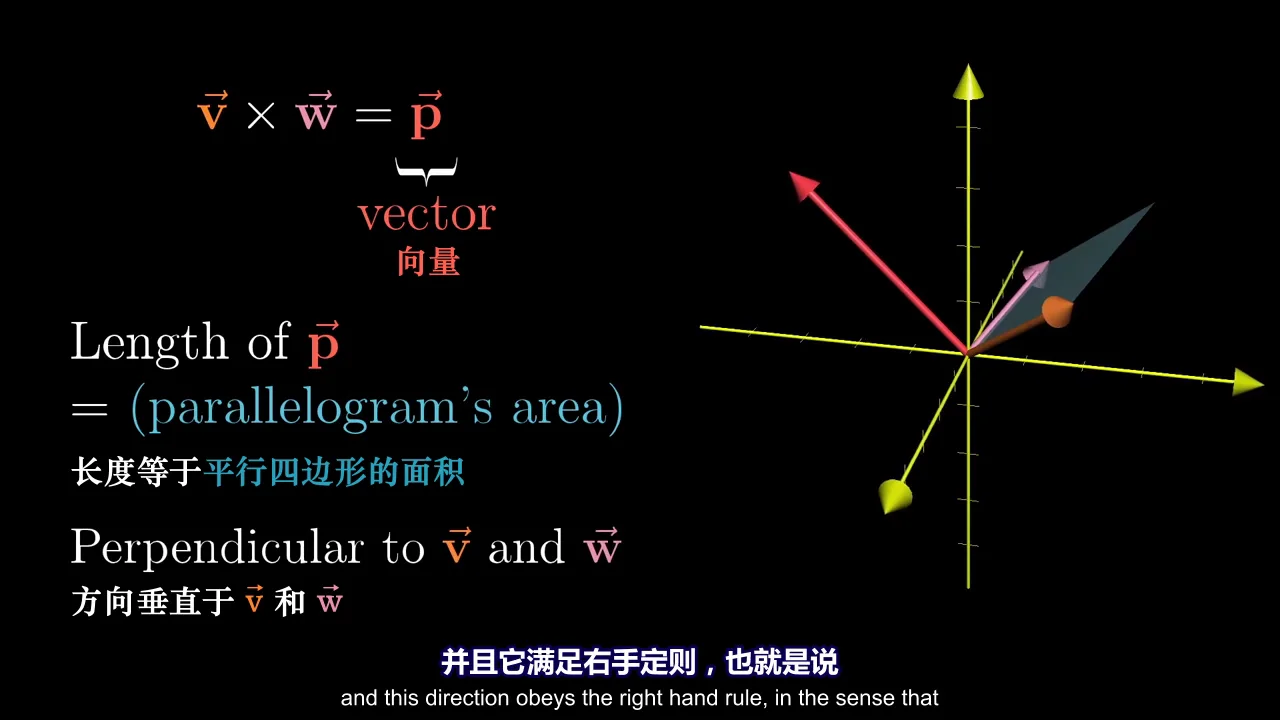
需要证明的三大几何特性:模长等于平行四边形面积、垂直于 $\vec{v},\vec{w}$、满足右手定则 01:30
需要证明的三大几何特性:模长等于平行四边形面积、垂直于 $\vec{v},\vec{w}$、满足右手定则画面重点:三维法向量 $\vec{p}$ 与几何性质文字汇总
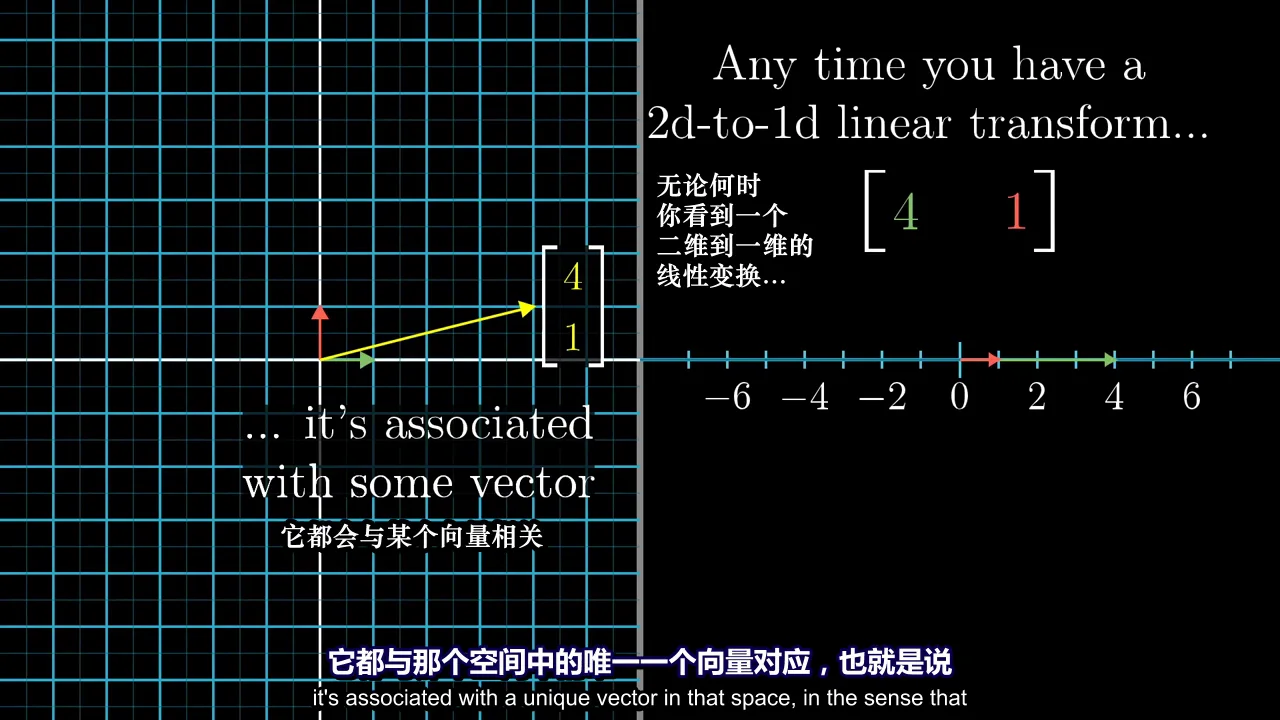
对偶性回顾:二维或高维空间到数轴的线性变换必然对应唯一向量 02:16
对偶性回顾:二维或高维空间到数轴的线性变换必然对应唯一向量画面重点:2d-to-1d 线性变换与对应向量回顾图
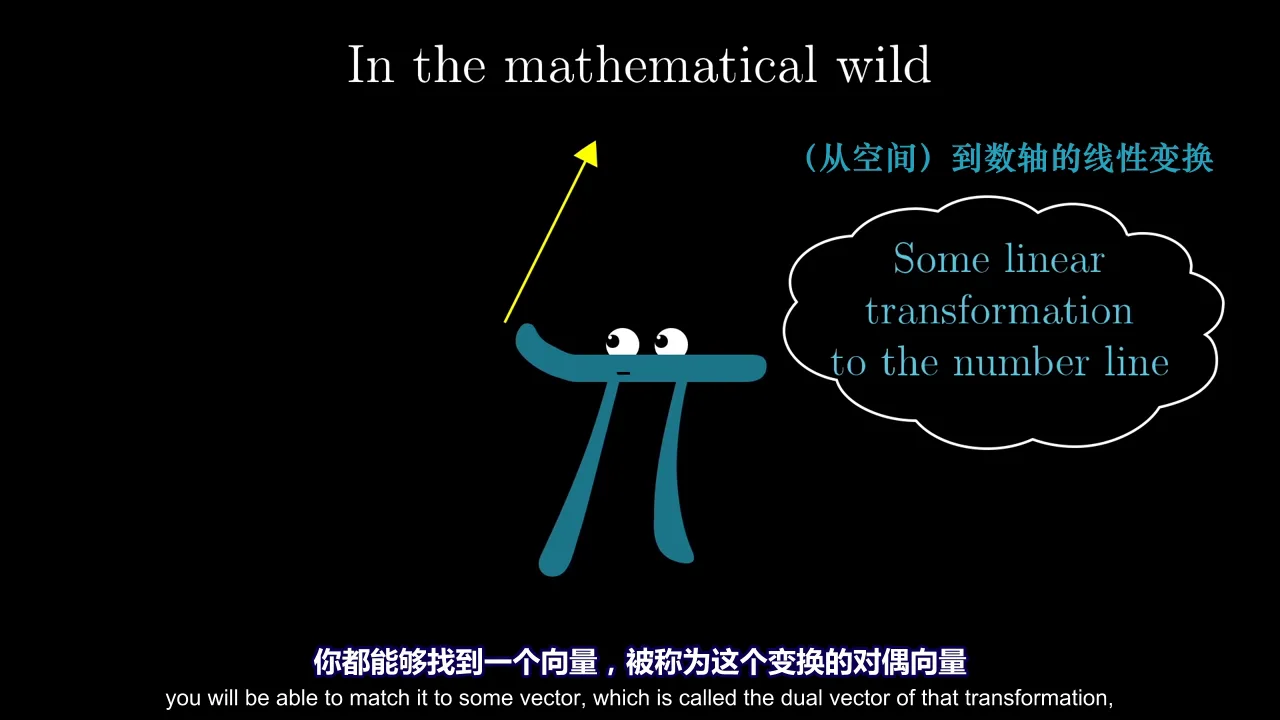
核心结论:把多维到一维线性变换匹配到其专属“对偶向量”(dual vector) 02:55
核心结论:把多维到一维线性变换匹配到其专属“对偶向量”(dual vector)画面重点:Pi 角色思考“In the mathematical wild”数轴变换气泡
[00:17] ↗
嘿,大家好!上次结束时 我们说到如何计算两个三维向量v和w的叉积
Hey folks, where we left off I was talking about how to compute a three-dimensional cross product between two vectors, v cross w.
[00:25] ↗
这个计算很有趣,你写下一个矩阵 它的第二列是v的坐标,第三列是w的坐标 但奇怪的是,第一列的元素是i帽、j帽和k帽 出于计算的原因,你假定它们都是数
It's this funny thing where you write a matrix whose second column has the coordinates of v, whose third column has the coordinates of w, but the entries of that first column, weirdly, are the symbols i-hat, j-hat, and k-hat, where you just pretend like those guys are numbers for the sake of computations.
[00:44] ↗
然后你再计算这个奇怪矩阵的行列式
Then with that funky matrix in hand, you compute its determinant.
[00:48] ↗
如果你忽略其中的古怪之处,一心扑在计算上 你会得到一个常数乘以i帽,加上一个常数乘以j帽,加上一个常数乘以k帽
If you just chug along with those computations, ignoring the weirdness, you get some constant times i-hat, plus some constant times j-hat, plus some constant times k-hat.
[01:00] ↗
你具体如何计算这个行列式无关紧要
How specifically you think about computing that determinant is kind of beside the point.
[01:05] ↗
重点在于你最终会得到三个数 可以分别解读为向量的坐标
All that really matters here is that you'll end up with three different numbers that are interpreted as the coordinates of some resulting vector.
[01:14] ↗
通常从这开始,老师也只是让学生相信 最终得到的向量有以下几何性质
From here, students are typically told to just believe that the resulting vector has the following geometric properties.
[01:20] ↗
它的长度等于v和w所确定的平行四边形的面积
Its length equals the area of the parallelogram defined by v and w.
[01:26] ↗
它的方向同时与v和w垂直 并且它满足右手定则,也就是说 如果(右手)食指指向v的方向,中指指向w的方向 那么当你竖起大拇指时,它指向所得向量的方向
It points in a direction perpendicular to both v and w, and this direction obeys the right-hand rule, in the sense that if you point your forefinger along v and your middle finger along w, then when you stick up your thumb, it'll point in the direction of the new vector.
[01:44] ↗
你可以通过蛮力计算来验证这些事实 但是我想和你分享一个非常优美的推理过程
There are some brute force computations that you could do to confirm these facts, but I want to share with you a really elegant line of reasoning.
[01:51] ↗
不过这个过程需要一些知识背景 所以在看这个视频前,我假定你们都已经看过第五章(行列式) 和第七章(对偶性)的视频
It leverages a bit of background, though, so for this video I'm assuming that everybody has watched chapter 5 on the determinant and chapter 7, where I introduced the idea of duality.
[02:05] ↗
快速回顾一下,对偶性的思想在于 每当你看到一个(多维)空间到数轴的线性变换时 它都与那个空间中的唯一一个向量对应,也就是说 应用线性变换和与这个向量点乘等价
As a quick reminder, the idea of duality is that any time you have a linear transformation from some space to the number line, it's associated with a unique vector in that space, in the sense that performing the linear transformation is the same as taking a dot product with that vector.
[02:22] ↗
数值上说,这是因为这类线性变换可以用一个只有一行的矩阵描述 而它的每一列给出了变换后基向量的位置
Numerically, this is because one of those transformations is described by a matrix with just one row, where each column tells you the number that each basis vector lands on.
[02:35] ↗
将这个矩阵与某个向量v相乘 在计算上与将矩阵转置得到的向量和v点乘相同
And multiplying this matrix by some vector v is computationally identical to taking the dot product between v and the vector you get by turning that matrix on its side.
[02:47] ↗
这里的收获在于,每当你看到一个从空间到数轴的线性变换 你都能够找到一个向量,被称为这个变换的对偶向量 使得应用线性变换和与对偶向量点乘等价
The takeaway is that whenever you're out in the mathematical wild and you find a linear transformation to the number line, you will be able to match it to some vector, which is called the dual vector of that transformation, so that performing the linear transformation is the same as taking a dot product with that vector.
[03:06] ↗
叉积的运算给出了此过程的一个鲜活实例
The cross product gives us a really slick example of this process in action.
[03:10] ↗
理解它需要下些功夫,但这绝对值得
It takes some effort, but it's definitely worth it.
[03:14] ↗
我要做的是定义一个从三维空间到数轴的特定线性变换 并且它是根据向量v和w来定义的
What I'm going to do is define a certain linear transformation from three dimensions to the number line, and it'll be defined in terms of the two vectors v and w.
[03:23] ↗
然后当我们将这个变换与三维空间中的对偶向量关联时 这个对偶向量就会是v和w的叉积
Then when we associate that transformation with its dual vector in 3D space, that dual vector is going to be the cross product of v and w.
[03:33] ↗
之所以这么做,是因为理解这个变换 能够解释清楚叉积的计算过程和几何含义之间的关系
The reason for doing this will be that understanding that transformation is going to make clear the connection between the computation and the geometry of the cross product.

构造从三维空间到数轴的行列式函数

⏱ 03:45 – 06:25

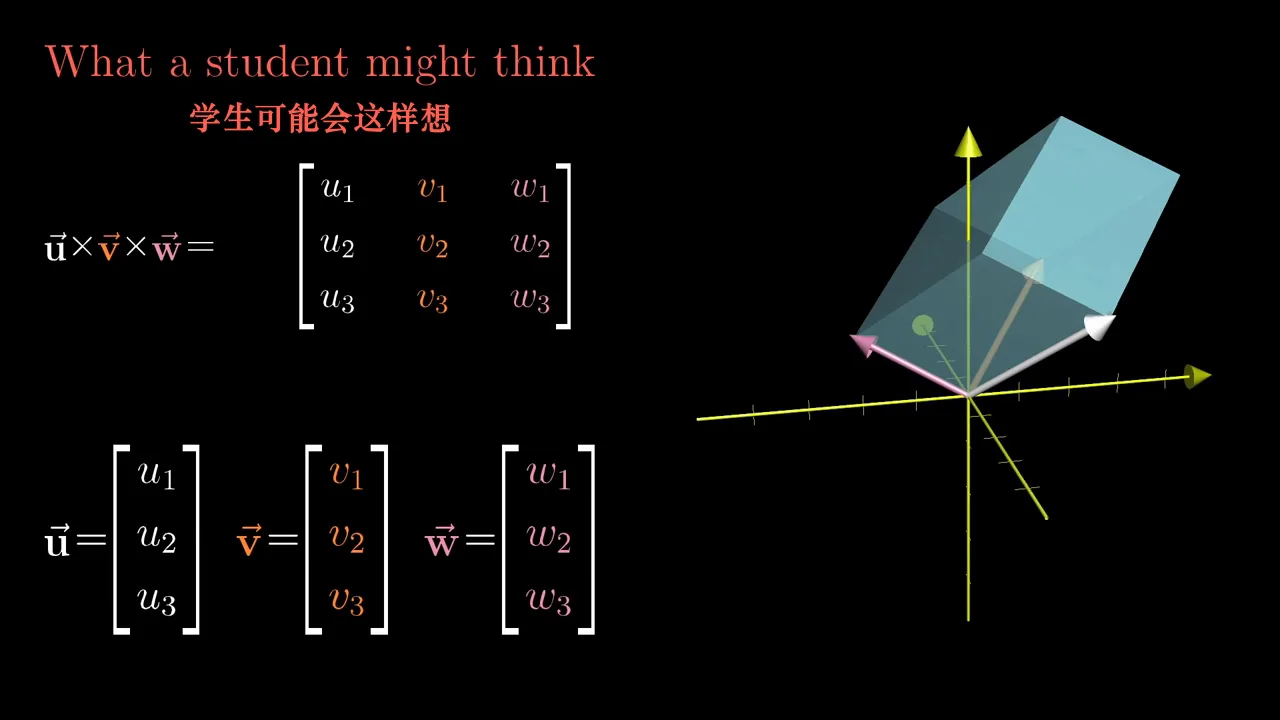
从二维外推到三维时,初学者很自然会想:二维叉积是把两个向量塞进 $2\times 2$ 矩阵求行列式(有向面积);那三维里把三个向量 $\vec{u},\vec{v},\vec{w}$ 塞进 $3\times 3$ 矩阵求行列式,得到的就是三者张成平行六面体的有向体积(正负由右手定则决定)。然而真正的三维叉积是吃进两个向量吐出一个向量,而不是吃进三个向量吐出一个数。

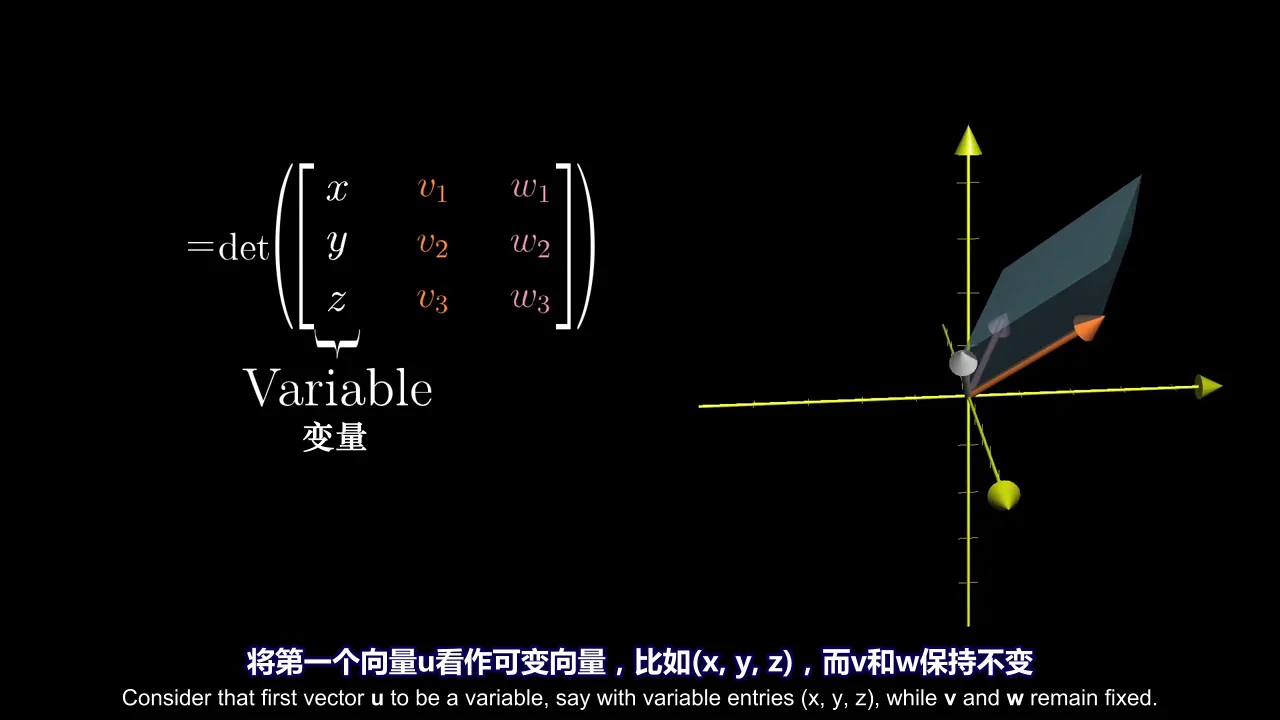
扭转视角的神来之笔在于:固定 $\vec{v}$ 和 $\vec{w}$,把第一个向量 $\vec{u}$ 解放成一个可变输入向量 $\vec{x}=(x,y,z)^T$!
📐 依赖 $\vec{v},\vec{w}$ 的 $\mathbb{R}^3\to\mathbb{R}$ 有向体积函数
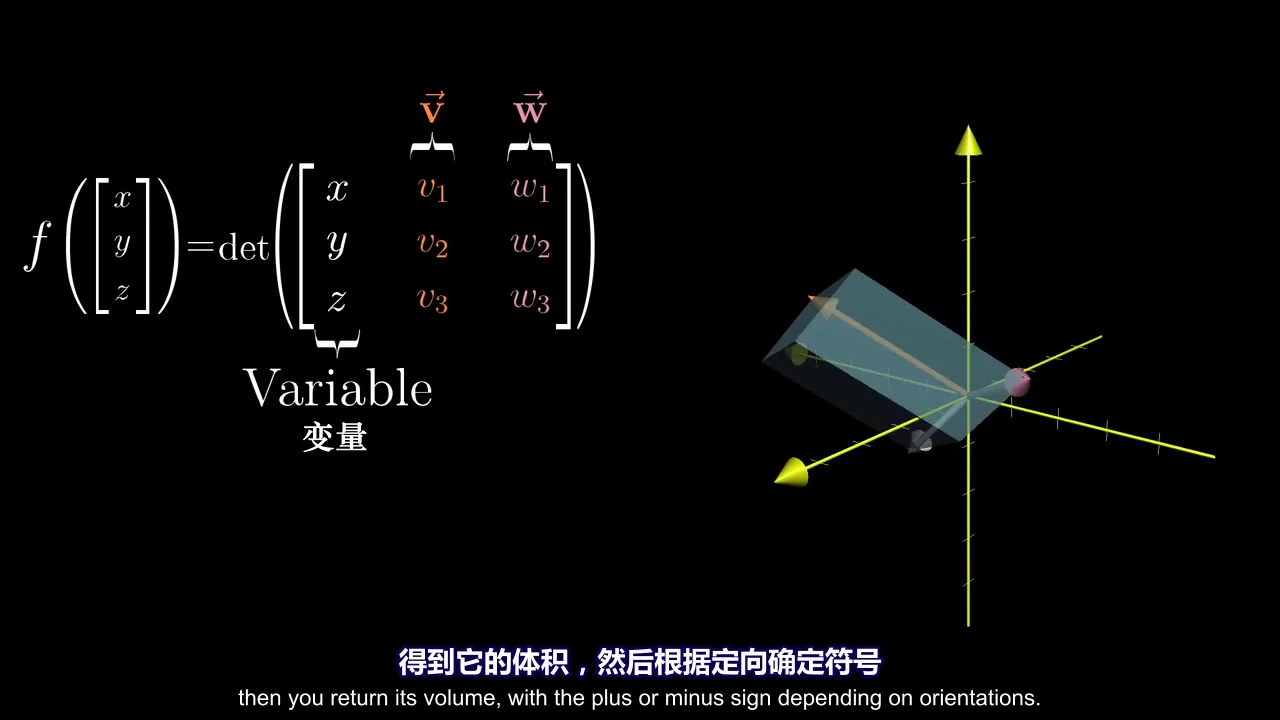
$$f\!\begin{bmatrix} x \\ y \\ z \end{bmatrix} = \det\begin{bmatrix} x & v_1 & w_1 \\ y & v_2 & w_2 \\ z & v_3 & w_3 \end{bmatrix}$$
几何含义:输入任一三维向量 $(x,y,z)$,返回它与固定向量 $\vec{v},\vec{w}$ 所张成平行六面体的有向体积。
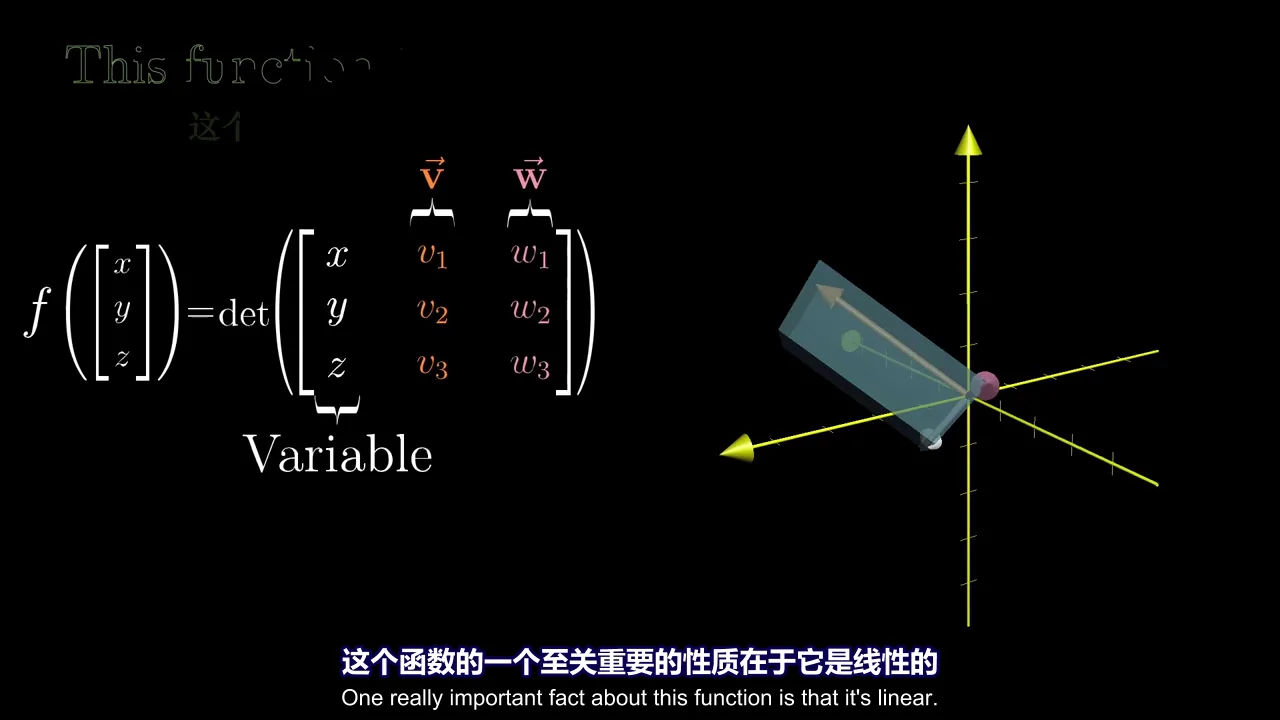
⚠️ 关键性质:为什么这个函数是线性的?
根据行列式的核心性质(或几何上把边 $\vec{x}$ 拉伸 $k$ 倍则平行六面体体积按底面积乘高同比例放大 $k$ 倍,且满足叠加性),$f(c\vec{x}_1+\vec{x}_2)=c f(\vec{x}_1)+f(\vec{x}_2)$ 严格成立。正因为 $f$ 是从三维空间到一维数轴的线性变换,对偶性武器正式登场!
二维对照回顾:两列向量构成的 $2\times 2$ 行列式直接给出有向面积 04:00
二维对照回顾:两列向量构成的 $2\times 2$ 行列式直接给出有向面积画面重点:二维平面中 $\vec{v},\vec{w}$ 向量及 $\det$ 算式
直观外推试探:三个三维向量 $\vec{u},\vec{v},\vec{w}$ 排成的 $3\times 3$ 行列式给出平行六面体有向体积 04:34
直观外推试探:三个三维向量 $\vec{u},\vec{v},\vec{w}$ 排成的 $3\times 3$ 行列式给出平行六面体有向体积画面重点:三列矩阵 $\det([\vec{u}\;\vec{v}\;\vec{w}])$ 与蓝色平行六面体
关键变招:将第一列固定向量改为可变输入向量 $(x,y,z)$,保持 $\vec{v},\vec{w}$ 不变 05:16
关键变招:将第一列固定向量改为可变输入向量 $(x,y,z)$,保持 $\vec{v},\vec{w}$ 不变画面重点:第一列高亮标注 Variable 的 $x,y,z$
定义完成:函数 $f(x,y,z)=\det([\vec{x},\vec{v},\vec{w}])$ 将空间点映射为平行六面体有向体积 05:53
定义完成:函数 $f(x,y,z)=\det([\vec{x},\vec{v},\vec{w}])$ 将空间点映射为平行六面体有向体积画面重点:$f([x,y,z]^T)=\det(...)$ 完整公式与三维几何体
线性性确认:由行列式基本性质可知该函数是从 $\mathbb{R}^3$ 到 $\mathbb{R}$ 的线性变换 06:17
线性性确认:由行列式基本性质可知该函数是从 $\mathbb{R}^3$ 到 $\mathbb{R}$ 的线性变换画面重点:This function is linear 醒目标注
[03:45] ↗
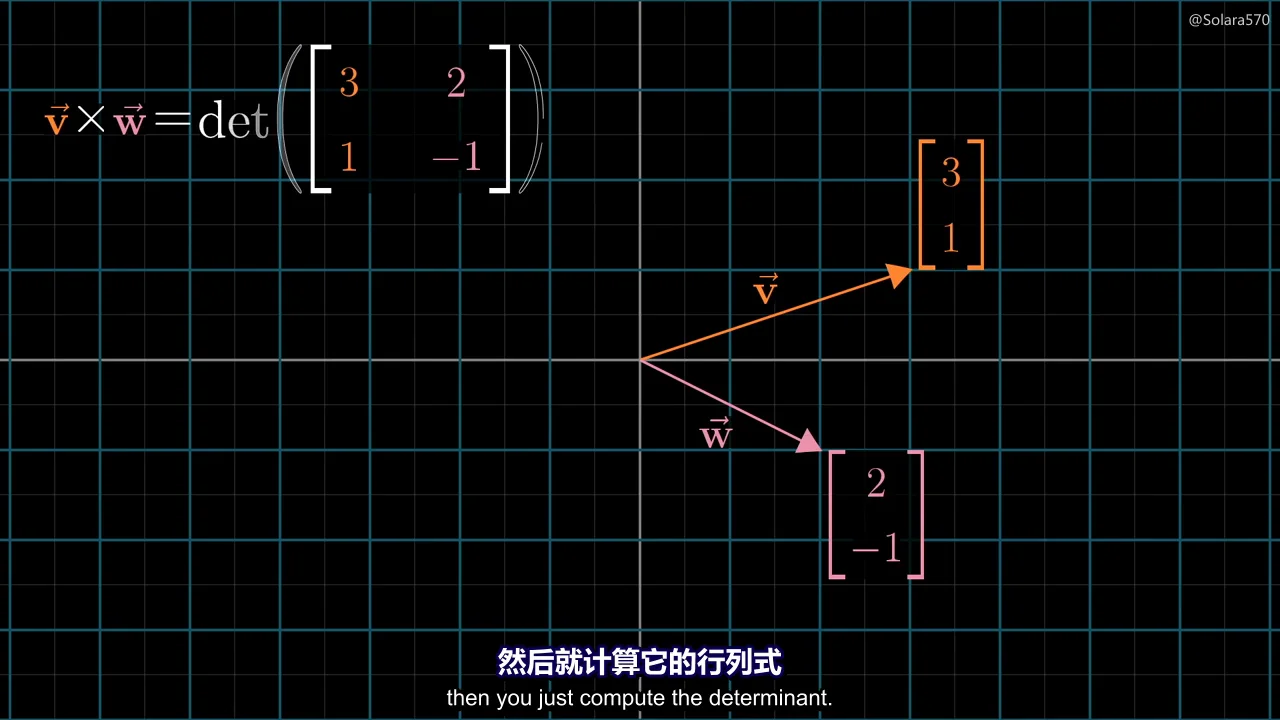
再回顾一下 还记得如何在二维空间中计算向量叉积吗?
So to back up a bit, remember in two dimensions what it meant to compute the 2D version of the cross product?
[03:51] ↗
你有两个向量v和w v的坐标作为矩阵第一列 w的坐标作为矩阵第二列
When you have two vectors v and w, you put the coordinates of v as the first column of a matrix and the coordinates of w as the second column of a matrix.
[04:00] ↗
然后就计算它的行列式
Then you just compute the determinant.
[04:02] ↗
这里没有出现基向量或者其他乱七八糟的东西 就是一个结果为数的普通行列式
There's no nonsense with basis vectors stuck in a matrix or anything like that, just an ordinary determinant returning a number.
[04:09] ↗
几何上说,它给出了两个向量张成的平行四边形的面积 它还可能出现负值,取决于两个向量的定向
Geometrically, this gives us the area of a parallelogram spanned out by those two vectors, with the possibility of being negative depending on the orientation of the vectors.
[04:20] ↗
如果你并不知道三维向量的叉积并且尝试去外推 你可能会想,它涉及三个向量u、v和w 将它们的坐标作为一个3×3矩阵的列 然后计算这个矩阵的行列式
Now, if you didn't already know the 3D cross product and you're trying to extrapolate, you might imagine that it involves taking three separate 3D vectors, u, v, and w, and making their coordinates the columns of a 3x3 matrix, then computing the determinant of that matrix.
[04:39] ↗
而且正如你从第五章里学到的 从几何上讲,这个行列式给出了三个向量张成的平行六面体的体积 外加一个正负号,取决于这三个向量是否满足右手定则
And as you know from chapter 5, geometrically this would give you the volume of a parallelepiped spanned out by those three vectors, with a plus or minus sign depending on the right hand rule orientation of those three vectors.
[04:53] ↗
当然,你们都知道这不是三维向量的叉积
Of course, you all know that this is not the 3D cross product.
[04:57] ↗
真正的三维向量的叉积接收两个向量并输出一个向量
The actual 3D cross product takes in two vectors and spits out a vector.
[05:03] ↗
它并不是接收三个向量并输出一个数
It doesn't take in three vectors and spit out a number.
[05:06] ↗
不过这个想法已经非常接近真实的叉积了
But this idea actually gets us really close to what the real cross product is.
[05:11] ↗
将第一个向量u看作可变向量,比如(x, y, z),而v和w保持不变
Consider that first vector u to be a variable, say with variable entries x, y, and z, while v and w remain fixed.
[05:23] ↗
那么我们就有一个从三维空间到数轴的函数了
What we have then is a function from three dimensions to the number line.
[05:27] ↗
你输入一个向量(x, y, z),然后通过矩阵的行列式得到一个数 这个向量的第一列是(x, y, z),其余两列是常向量v和w的坐标
You input some vector x, y, z and you get out a number by taking the determinant of a matrix whose first column is x, y, z and whose other two columns are the coordinates of the constant vectors v and w.
[05:41] ↗
这个函数的几何意义是,对于任一输入的向量(x, y, z) 你都考虑由它和v与w确定的平行六面体
Geometrically, the meaning of this function is that for any input vector x, y, z, you consider the parallelepiped defined by this vector v and w.
[05:51] ↗
得到它的体积,然后根据定向确定符号
Then you return its volume with a plus or minus sign depending on orientation.
[05:58] ↗
这看上去感觉是一件很随意的事
Now, this might feel like kind of a random thing to do.
[06:00] ↗
我是说,这个函数从哪里来的?为什么要这样定义?
I mean, where does this function come from?
[06:02] ↗
我是说,这个函数从哪里来的?为什么要这样定义?
Why are we defining it this way?
[06:04] ↗
我得承认,眼下你可能会感觉它出乎你的意料
And I'll admit, at this stage it might kind of feel like it's coming out of the blue.
[06:07] ↗
不过如果你愿意接受它,对它具有的性质进行试验 这对理解叉积很关键
But if you're willing to go along with it and play around with the properties that this guy has, it's the key to understanding the cross product.
[06:15] ↗
这个函数的一个至关重要的性质在于它是线性的
One really important fact about this function is that it's linear.
[06:20] ↗
我想把这个问题留给你来解决:根据行列式的性质说明这一点为什么正确
I'll actually leave it to you to work through the details of why this is true based on properties of the determinant.

计算视角:为何对偶向量恰好给出伪行列式

⏱ 06:26 – 09:20

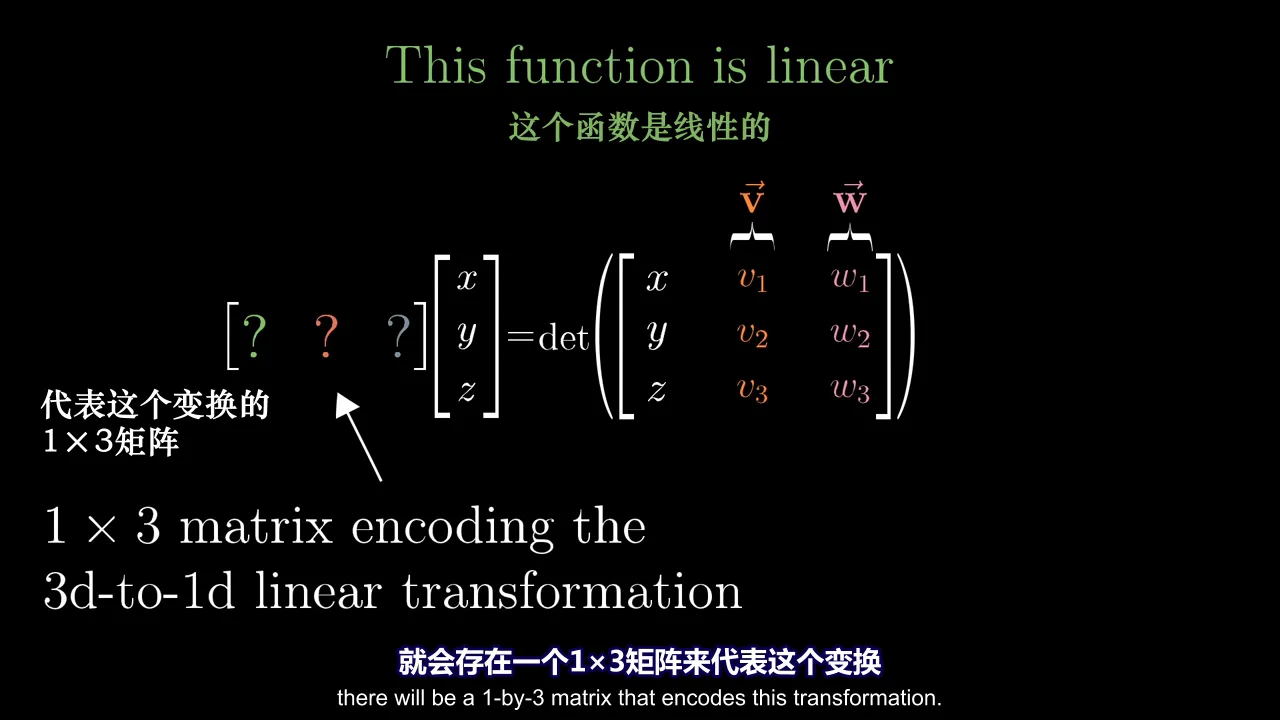
既然 $f:\mathbb{R}^3\to\mathbb{R}$ 是线性的,它就能被一个 $1\times 3$ 矩阵唯一编码;将其立起来,就存在唯一的三维对偶向量 $\vec{p}=(p_1,p_2,p_3)^T$,使得对空间中所有 $(x,y,z)$ 都成立:
📐 求解对偶向量的代数比对
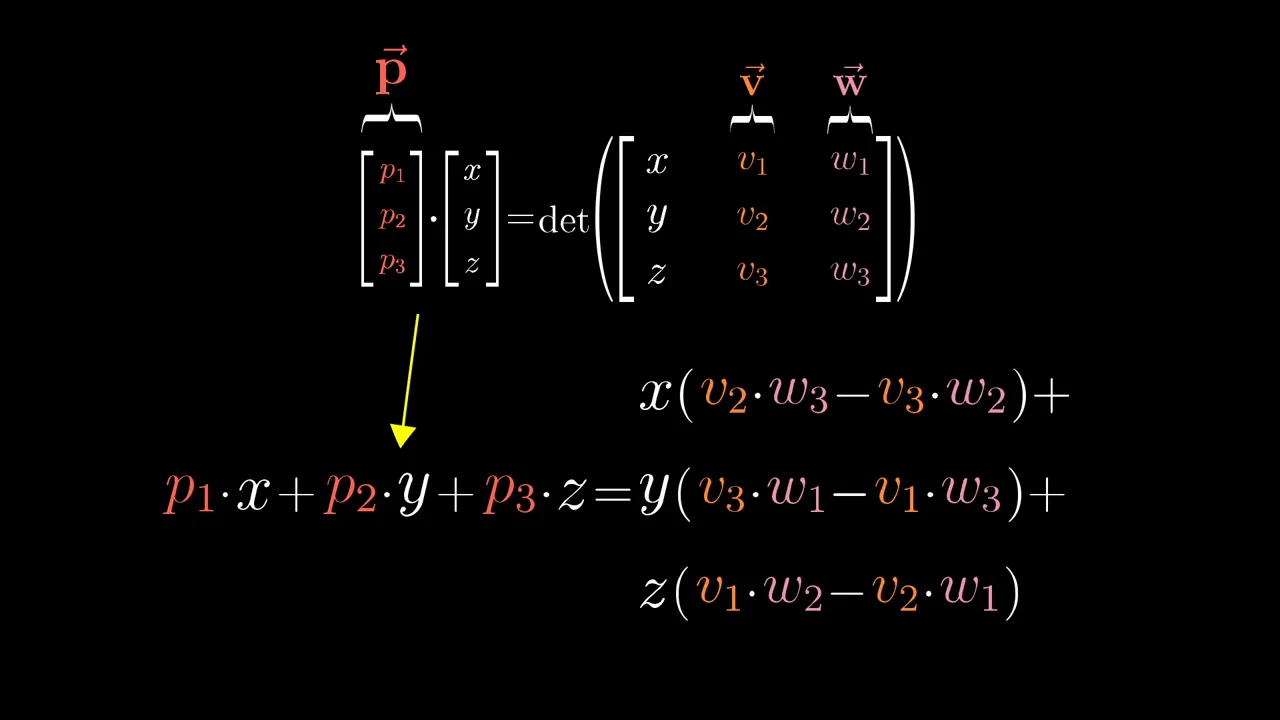
$$\begin{bmatrix} p_1 \\ p_2 \\ p_3 \end{bmatrix}\cdot\begin{bmatrix} x \\ y \\ z \end{bmatrix} = p_1 x + p_2 y + p_3 z = x(v_2 w_3 - v_3 w_2) + y(v_3 w_1 - v_1 w_3) + z(v_1 w_2 - v_2 w_1)$$
左端是点积展开,右端是行列式按第一列展开后整理成 $x,y,z$ 的线性组合;比对系数即得 $p_1,p_2,p_3$。
💡 揭秘伪行列式里 $\hat{\imath},\hat{\jmath},\hat{k}$ 的真实身份
把第一列的变量 $(x,y,z)$ 替换成符号 $\hat{\imath}$、$\hat{\jmath}$、$\hat{k}$ 并按行列式展开,本质上和整理上面右式中的 $x,y,z$ 系数没有任何区别!把 $\hat{\imath},\hat{\jmath},\hat{k}$ 塞进矩阵,仅仅是一种“记号信号”,告诉我们把收集到的三个系数拼成向量 $\vec{p}$ 的三个坐标。换句话说,伪行列式求出的正是满足 $\vec{p}\cdot\vec{x}=\det([\vec{x}\;\vec{v}\;\vec{w}])$ 的那个对偶向量 $\vec{p}$!
用 $1\times 3$ 矩阵编码这个三维到一维的线性变换 06:47
用 $1\times 3$ 矩阵编码这个三维到一维的线性变换画面重点:$[?\; ?\; ?]$ 行矩阵与三阶行列式的等价关系
引入对偶向量 $\vec{p}$:满足对任意 $(x,y,z)$ 都有 $\vec{p}\cdot[x,y,z]^T = \det([\vec{x},\vec{v},\vec{w}])$ 07:24
引入对偶向量 $\vec{p}$:满足对任意 $(x,y,z)$ 都有 $\vec{p}\cdot[x,y,z]^T = \det([\vec{x},\vec{v},\vec{w}])$画面重点:橙色向量 $\vec{p}$ 与点积等于行列式方程
代数对比:左边展开为 $p_1 x+p_2 y+p_3 z$,右边按第一列展开整理出 $x,y,z$ 的组合系数 07:58
代数对比:左边展开为 $p_1 x+p_2 y+p_3 z$,右边按第一列展开整理出 $x,y,z$ 的组合系数画面重点:上下对应展示 $p_1,p_2,p_3$ 与行列式余子式系数的匹配
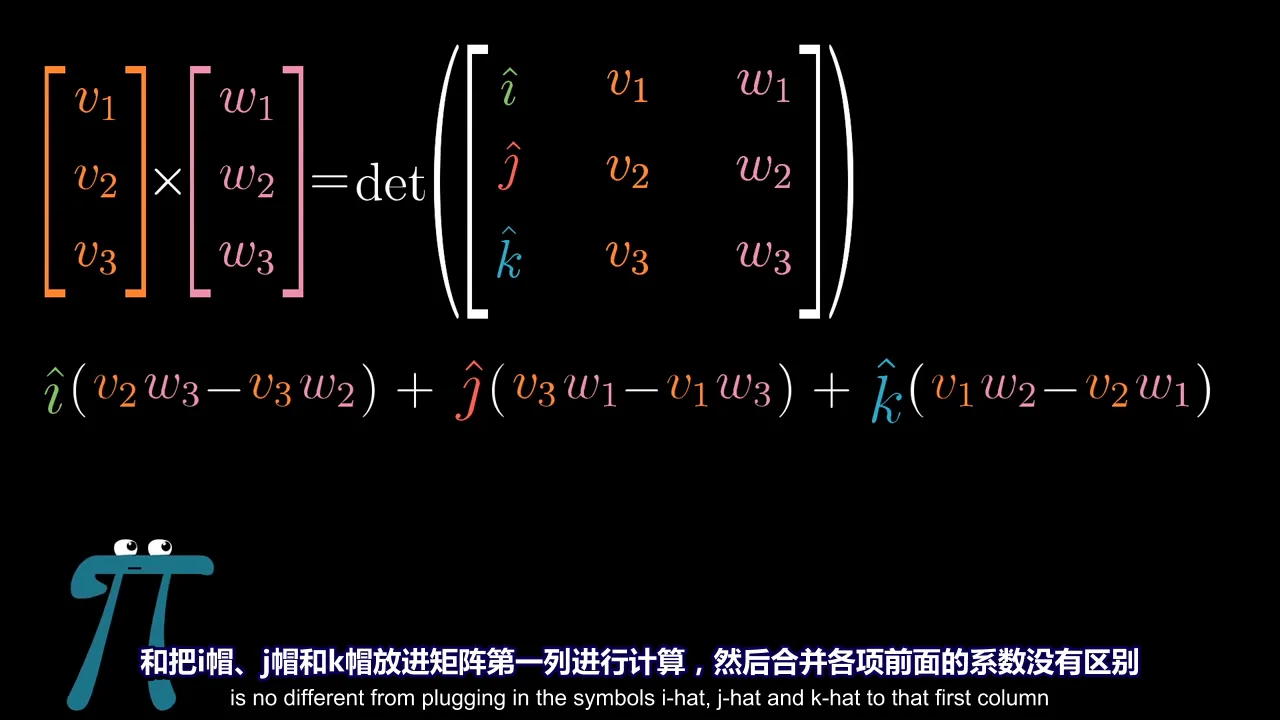
顿悟时刻:把第一列换作 $\hat{\imath},\hat{\jmath},\hat{k}$ 计算,不过是把 $x,y,z$ 的系数标记为向量坐标 08:36
顿悟时刻:把第一列换作 $\hat{\imath},\hat{\jmath},\hat{k}$ 计算,不过是把 $x,y,z$ 的系数标记为向量坐标画面重点:伪行列式展开式与系数提取对照
[06:26] ↗
一旦你知道它是线性的,我们就能开始引进对偶性的思想了
But once you know that it's linear, we can start bringing in the idea of duality.
[06:35] ↗
一旦知道它是线性的,你就知道可以通过矩阵乘法来描述这个函数
Once you know that it's linear, you know that there's some way to describe this function as matrix multiplication.
[06:41] ↗
具体地说,因为这个函数从三维空间到一维空间 就会存在一个1×3矩阵来代表这个变换
Specifically, since it's a function that goes from three dimensions to one dimension, there will be a one by three matrix that encodes this transformation.
[06:53] ↗
而对偶性的整体思路是 从多维空间到一维空间的变换的特别之处 在于你可以将这个矩阵立起来 并且将整个变换看作与这个特定向量的点积
And the whole idea of duality is that the special thing about transformations from several dimensions to one dimension is that you can turn that matrix on its side and instead interpret the entire transformation as the dot product with a certain vector.
[07:08] ↗
我们要找的就是这个特殊的三维向量 - 我称之为p 使得p与其他任一向量(x, y, z)的点积等于一个3×3矩阵的行列式 这个3×3矩阵的第一列为(x, y, z) 其余两列分别为v和w的坐标
What we're looking for is the special 3D vector that I'll call p such that taking the dot product between p and any other vector x, y, z gives the same result as plugging in x, y, z as the first column of a three by three matrix whose other two columns have the coordinates of v and w, then computing the determinant.
[07:29] ↗
我稍后会说到这个过程的几何意义 但是我们现在先专注于它的计算意义
I'll get to the geometry of this in just a moment, but right now let's dig in and think about what this means computationally.
[07:36] ↗
p与向量(x, y, z)点乘给出的结果是 某个数乘以x,加上某个数乘以y,加上某个数乘以z 这里的某些数就是p的坐标
Taking the dot product between p and x, y, z will give us something times x plus something times y plus something times z, where those somethings are the coordinates of p.
[07:48] ↗
但是当你计算等号右侧的行列式时,你可以将其整理为 某个常数乘以x,加上某个常数乘以y,加上某个常数乘以z 这里的某些常数涉及了v和w的坐标的特定组合
But on the right side here, when you compute the determinant, you can organize it to look like some constant times x plus some constant times y plus some constant times z, where those constants involve certain combinations of the components of v and w.
[08:04] ↗
因此这些常数,也就是v和w的坐标的特定组合 就是我们寻找的向量p的坐标
So those constants, those particular combinations of the coordinates of v and w are going to be the coordinates of the vector p that we're looking for.
[08:18] ↗
等号右侧的过程 对于那些进行过叉积计算的人来说是很熟悉的
But what's going on on the right here should feel very familiar to anyone who's actually worked through a cross product computation.
[08:26] ↗
像这样合并x、y和z前面的常数项 和把i帽、j帽和k帽放进矩阵第一列进行计算,然后合并各项前面的系数没有区别
Collecting the constant terms that are multiplied by x, y, and by z like this is no different from plugging in the symbols i-hat, j-hat, and k-hat to that first column, and seeing which coefficients aggregate on each one of those terms.
[08:41] ↗
在矩阵中插入i帽、j帽和k帽不过是在传递一个信号 告诉我们应该把这些系数解读为一个向量的坐标
It's just that plugging in i-hat, j-hat, and k-hat is a way of signaling that we should interpret those coefficients as the coordinates of a vector.
[08:51] ↗
因此,这一切都在说明 这个奇怪的运算过程可以看作是以下问题的答案
So what all of this is saying is that this funky computation can be thought of as a way to answer the following question.
[08:58] ↗
当你将向量p和某个向量(x, y, z)点乘时,所得结果等于一个3×3矩阵的行列式 这个矩阵第一列为(x, y, z),其余两列为v和w的坐标 什么样的向量p才能满足这一特殊性质?
What vector p has the special property that when you take a dot product between p and some vector x, y, z, it gives the same result as plugging in x, y, z to the first column of a matrix whose other two columns have the coordinates of v and w, then computing the determinant.
[09:16] ↗
可能有些拗口,不过在这期视频里,它是一个需要理解的重要问题
That's a bit of a mouthful, but it's an important question to digest for this video.

几何视角:平行六面体体积与点积投影的完美统一

⏱ 09:21 – 12:54

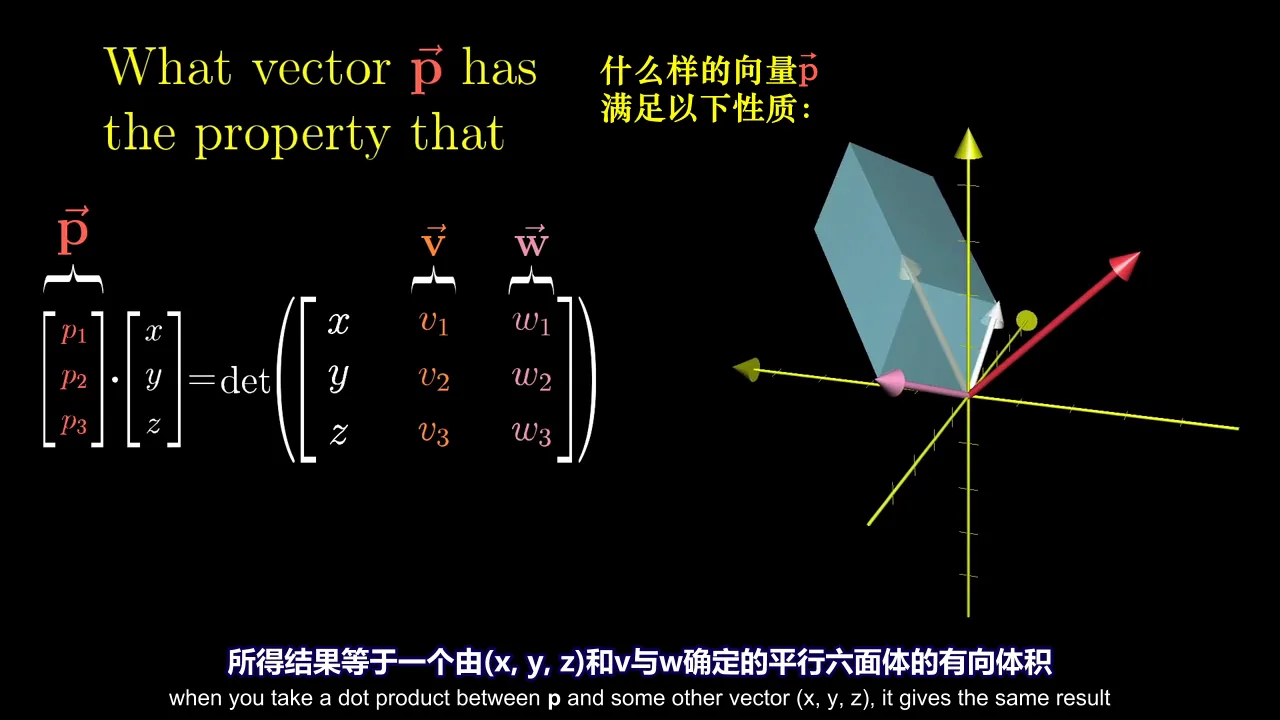
现在抛开计算,换用纯几何语言重新回答同一个问题:空间中哪一个向量 $\vec{p}$,能使得对任意向量 $(x,y,z)$,点积 $\vec{p}\cdot(x,y,z)$ 恰好等于由 $(x,y,z)$、$\vec{v}$ 与 $\vec{w}$ 张成的平行六面体的有向体积?

拆解平行六面体的体积公式:体积 $=$ 底面积 $\times$ 高。其中底面就是 $\vec{v}$ 与 $\vec{w}$ 张成的平行四边形,面积记为 $A$;而高则是输入向量 $(x,y,z)$ 沿垂直于该底面直线方向的投影分量(有符号)!
📐 几何构造出的对偶向量唯一满足三大叉积条件
$$\vec{p}\cdot\vec{x} = \|\vec{p}\|\cdot\operatorname{proj}_{\vec{p}}(\vec{x}) = \underbrace{\operatorname{Area}(\vec{v},\vec{w})}_{\|\vec{p}\|} \cdot \underbrace{(\text{沿垂直 }\vec{v},\vec{w}\text{ 方向的分量})}_{\text{投影分量}}$$
对比点积的几何定义(把 $\vec{x}$ 投影到 $\vec{p}$ 再乘以 $\|\vec{p}\|$):$\vec{p}$ 必须垂直于 $\vec{v},\vec{w}$、模长等于平行四边形面积 $A$,且指向必须服从右手定则,才能使点积符号与右手定向体积正负完全吻合。
💡 双剑合璧:代数与几何在“对偶性”处汇合
至此闭环完成:代数伪行列式计算出的向量,是线性变换 $f$ 的对偶向量;几何法向与面积构造出的向量,也是同一个线性变换 $f$ 的对偶向量。既然同一个线性变换的对偶向量在空间中唯一存在,这两个向量就必然完全相等——这就是叉积代数公式与几何直觉严丝合缝的根本原因!
纯几何视角重问核心命题:什么向量 $\vec{p}$ 满足与 $(x,y,z)$ 的点积等于平行六面体有向体积? 09:45
纯几何视角重问核心命题:什么向量 $\vec{p}$ 满足与 $(x,y,z)$ 的点积等于平行六面体有向体积?画面重点:What vector $\vec{p}$ has the property that... 与三维体积图示
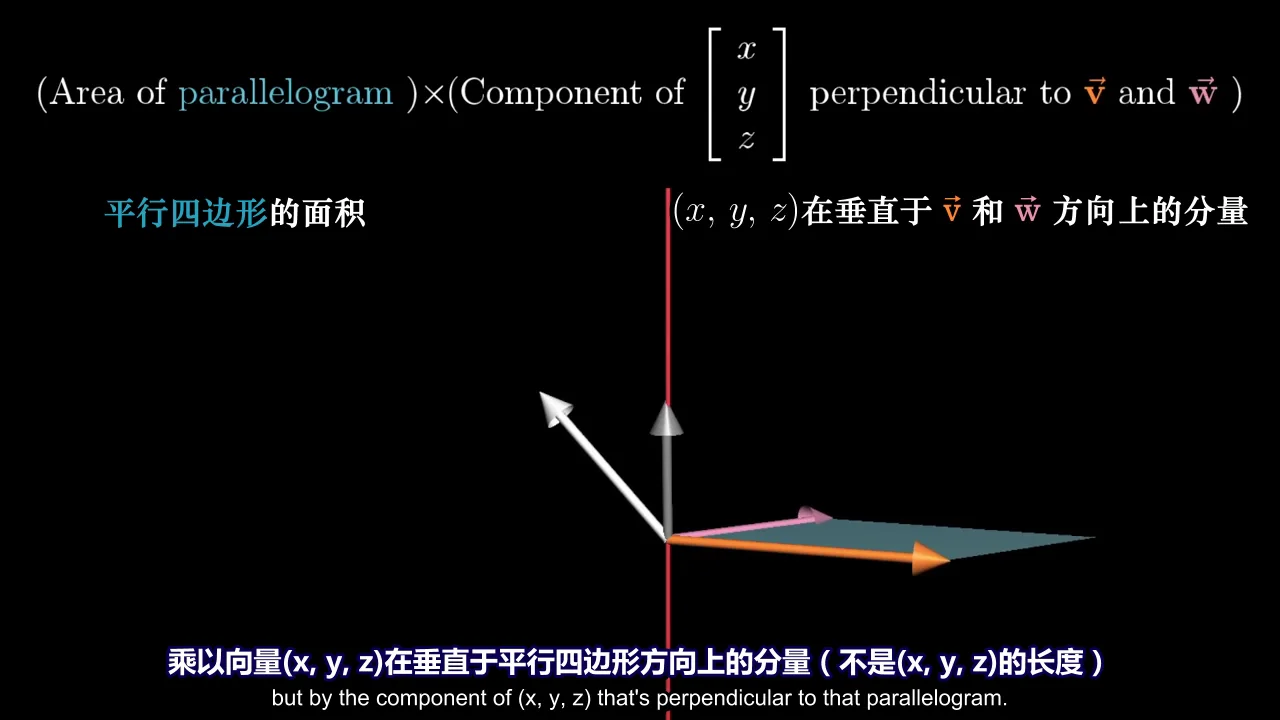
体积分解关键一步:底平行四边形面积 $\times$ 向量 $(x,y,z)$ 在垂直于 $\vec{v},\vec{w}$ 方向上的分量 10:32
体积分解关键一步:底平行四边形面积 $\times$ 向量 $(x,y,z)$ 在垂直于 $\vec{v},\vec{w}$ 方向上的分量画面重点:底面积与垂直高度分量分解公式与法向箭头
几何识别:将 $(x,y,z)$ 投影到垂直直线再乘以底面积,正等价于与垂直向量 $\vec{p}$ 做点积 10:58
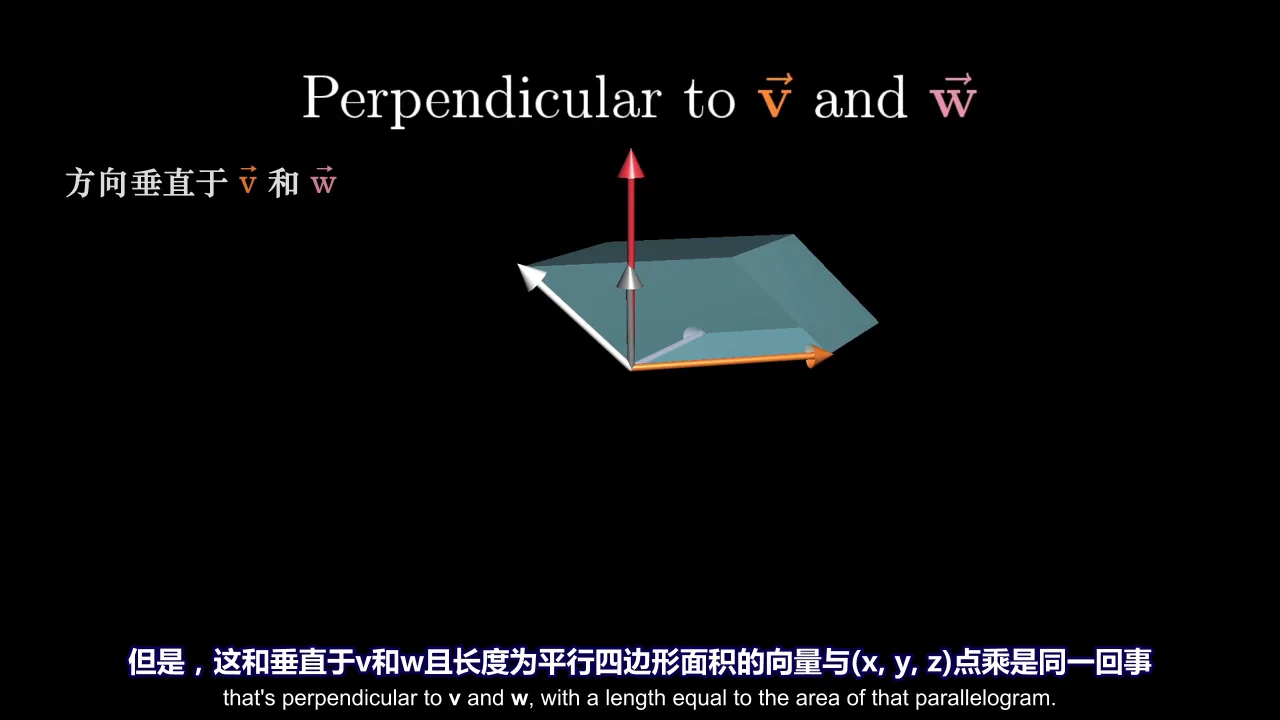
几何识别:将 $(x,y,z)$ 投影到垂直直线再乘以底面积,正等价于与垂直向量 $\vec{p}$ 做点积画面重点:Perpendicular to $\vec{v}$ and $\vec{w}$ 标注及法向量方向
定向吻合:按右手定则选取 $\vec{p}$ 指向后,点积正负号与有向体积定向正负号完全一致 11:13
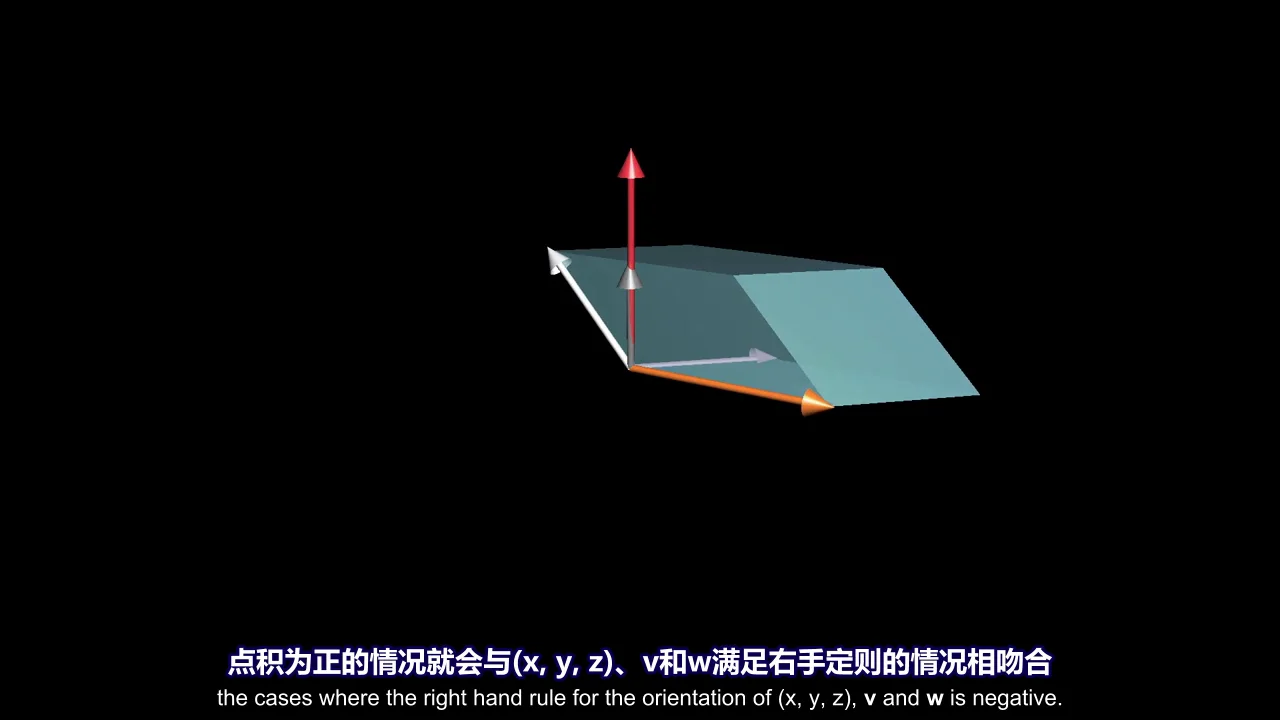
定向吻合:按右手定则选取 $\vec{p}$ 指向后,点积正负号与有向体积定向正负号完全一致画面重点:右手定则下的平行六面体与法向量方向
最终大一统:伪行列式求出的分量坐标与几何法向面积向量同为 $f$ 的唯一对偶向量,故必然相等 11:40
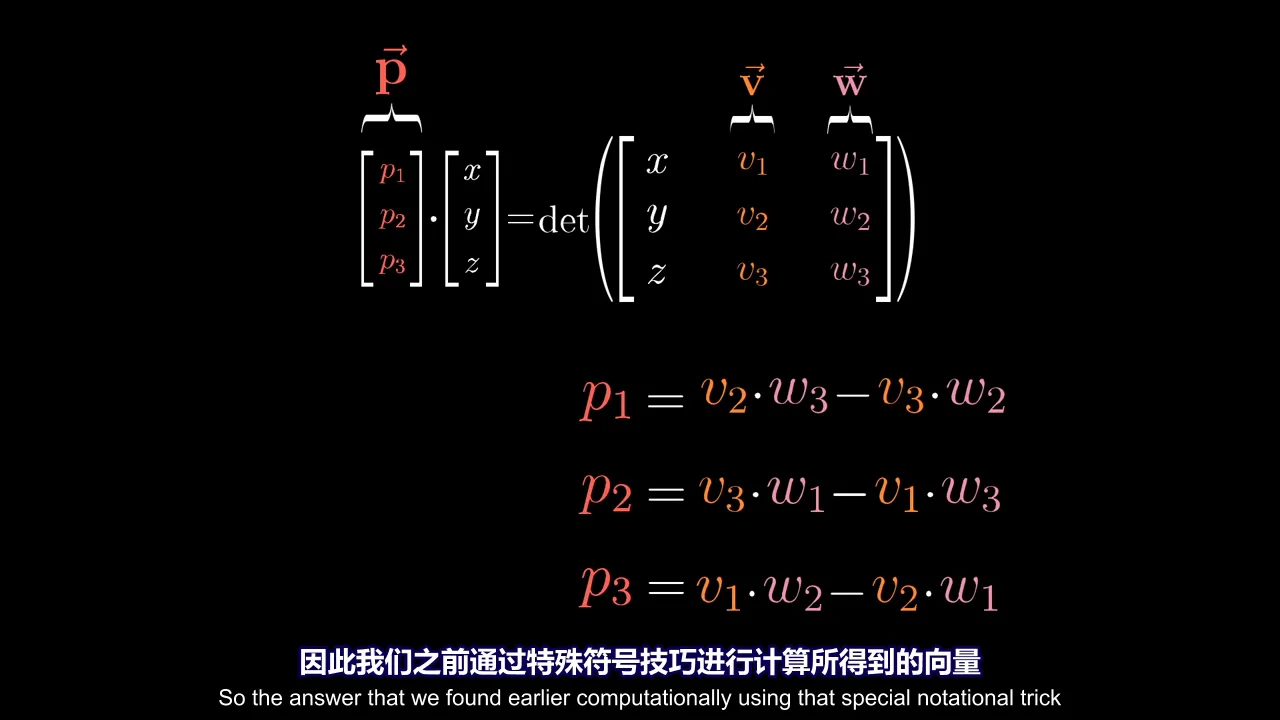
最终大一统:伪行列式求出的分量坐标与几何法向面积向量同为 $f$ 的唯一对偶向量,故必然相等画面重点:对偶向量 $\vec{p}$ 三个坐标公式 $p_1,p_2,p_3$ 最终汇总
[09:21] ↗
接下来是精彩的部分 它将上面的内容与上期视频中介绍的叉积的几何意义联系起来
Now for the cool part, which ties all this together with the geometric understanding of the cross product that I introduced last video.
[09:29] ↗
我会再问一次相同的问题 不过这次,我们要尝试从几何角度回答,而不是从计算角度回答
I'm going to ask the same question again, but this time we're going to try to answer it geometrically instead of computationally.
[09:36] ↗
当你将向量p和某个向量(x ,y, z)点乘时 所得结果等于一个由(x, y, z)和v与w确定的平行六面体的有向体积 什么样的向量p才能满足这一特殊性质?
What 3D vector p has the special property that when you take a dot product between p and some other vector x, y, z, it gives the same result as if you took the signed volume of a parallelepiped defined by this vector x, y, z along with v and w.
[09:57] ↗
记住一点,向量p与其他向量的点积的几何解释 是将其他向量投影到p上 然后将投影长度与p的长度相乘
Remember, the geometric interpretation of a dot product between a vector p and some other vector is to project that other vector onto p, then to multiply the length of that projection by the length of p.
[10:13] ↗
考虑到这一点,对于我们所关心的平行六面体的体积,我来说明一种思考方法
With that in mind, let me show a certain way to think about the volume of the parallelepiped that we care about.
[10:20] ↗
首先获得由v和w确定的平行四边形的面积 乘以向量(x, y, z)在垂直于平行四边形方向上的分量(不是(x, y, z)的长度)
Start by taking the area of the parallelogram defined by v and w, then multiply it not by the length of x, y, z, but by the component of x, y, z that's perpendicular to that parallelogram.
[10:34] ↗
换句话说,我们找到的线性函数对于给定向量的作用 是将这个向量投影到垂直于v和w的直线上 然后将投影长度与v和w张成的平行四边形的面积相乘
In other words, the way our linear function works on a given vector is to project that vector onto a line that's perpendicular to both v and w, then to multiply the length of that projection by the area of the parallelogram spanned by v and w.
[10:52] ↗
但是,这和垂直于v和w且长度为平行四边形面积的向量与(x, y, z)点乘是同一回事
But this is the same thing as taking a dot product between x, y, z and a vector that's perpendicular to v and w with a length equal to the area of that parallelogram.
[11:03] ↗
更重要的是,如果你选择了合适的向量方向 点积为正的情况就会与(x, y, z)、v和w满足右手定则的情况相吻合
What's more, if you choose the appropriate direction for that vector, the cases where the dot product is negative will line up with the cases where the right hand rule for the orientation of x, y, z, v and w is negative.
[11:20] ↗
这意味着我们找到了一个向量p 使得p与和某个向量(x, y, z)点乘时 所得结果等于一个3×3矩阵的行列式 这个矩阵的三列分别为(x, y, z)、v的坐标和w的坐标
This means that we just found a vector p so that taking a dot product between p and some vector x, y, z is the same thing as computing that determinant of a 3x3 matrix whose columns are x, y, z, the coordinates of v and w.
[11:35] ↗
因此我们之前通过特殊符号技巧进行计算所得到的向量 必然在几何上与这个向量对应
So the answer that we found earlier computationally using that special notational trick must correspond geometrically to this vector.
[11:44] ↗
这就是叉积的计算过程与几何解释有关联的根本原因
This is the fundamental reason why the computation and the geometric interpretation of the cross product are related.
[11:53] ↗
简单总结一下之前的内容 我首先定义了一个三维空间到数轴的线性变换 并且它是根据向量v和w来定义的
Just to sum up what happened here, I started by defining a linear transformation from 3D space to the number line, and it was defined in terms of the vectors v and w.
[12:03] ↗
然后我通过两种不同的方式来考虑这个变换的对偶向量 即应用这个变换和与对偶向量点乘等价
Then I went through two separate ways to think about the dual vector of this transformation, the vector such that applying the transformation is the same thing as taking a dot product with that vector.
[12:15] ↗
一方面,计算方法引导你使用下面这种技巧 在矩阵第一列中插入i帽、j帽和k帽,然后计算行列式
On the one hand, a computational approach will lead you to the trick of plugging in the symbols i-hat, j-hat, and k-hat to the first column of a matrix and computing the determinant.
[12:26] ↗
但是从几何角度思考,我们可以推断出这个对偶向量 必然与v和w垂直,并且其长度与这两个向量张成的平行四边形的面积相同
But thinking geometrically, we can deduce that this dual vector must be perpendicular to v and w with a length equal to the area of the parallelogram spanned out by those two vectors.
[12:39] ↗
这两种方法给出了同一个变换的对偶向量,因此这两个向量必然相同
Since both of these approaches give us a dual vector to the same transformation, they must be the same vector.
[12:47] ↗
点积和叉积部分的内容就此圆满结束 下期视频是线性代数中一个非常重要的概念——基变换
So that wraps up dot products and cross products, and the next video will be a really important concept for linear algebra, change of basis.

📝 几何直觉自测(点击题目展开解答)

Q1. 本讲为了解释三维叉积构造了哪一个 $\mathbb{R}^3\to\mathbb{R}$ 的线性变换?它如何随着输入向量 $(x,y,z)$ 变化?▼
将两个给定向量 $\vec{v},\vec{w}$ 固定为 $3\times 3$ 矩阵的第二、三列,把第一列设为变量向量 $\vec{x}=(x,y,z)^T$,定义 $f(\vec{x})=\det([\vec{x}\;\vec{v}\;\vec{w}])$。几何上它返回 $\vec{x},\vec{v},\vec{w}$ 张成平行六面体的有向体积。
Q2. 在 $3\times 3$ 伪行列式矩阵的第一列写入 $\hat{\imath},\hat{\jmath},\hat{k}$ 而不是数字,在数学上到底代表什么含义?▼
线性变换 $f(\vec{x})=\det([\vec{x}\;\vec{v}\;\vec{w}])$ 按第一列展开可写成 $c_1 x + c_2 y + c_3 z = \vec{p}\cdot\vec{x}$,其中 $(c_1,c_2,c_3)$ 正是对偶向量 $\vec{p}$ 的三个坐标。将第一列的 $(x,y,z)$ 换成基向量符号 $\hat{\imath},\hat{\jmath},\hat{k}$,本质上是把待求的线性系数 $c_1,c_2,c_3$ 标明为向量的三个坐标分量。
Q3. 不进行任何坐标展开,为什么从平行六面体的体积公式就能直接推出对偶向量 $\vec{p}$ 的长度和方向?▼
平行六面体有向体积等于固定底面 $(\vec{v},\vec{w})$ 的面积 $A$ 乘以 $\vec{x}$ 沿底面法向直线投影的有向长度;而这在几何上恰等于“把 $\vec{x}$ 投影到法向量 $\vec{p}$ 上再乘以 $\|\vec{p}\|$”,即 $\vec{p}\cdot\vec{x}$。因此 $\vec{p}$ 必垂直于 $\vec{v},\vec{w}$,长度必等于底面积 $A$,且指向须使点积符号与右手定向体积正负一致。
Q4. 证明的最后一步依赖于对偶向量的哪一条关键性质?▼
唯一性:从 $\mathbb{R}^3$ 到 $\mathbb{R}$ 的任意一个线性变换都对应空间中**唯一**的对偶向量。既然代数伪行列式计算出的向量与几何性质确定的向量都是同一变换 $f$ 的对偶向量,它们必然是完全相同的向量。