线性代数的本质 · 精研复习站

第 11 集:抽象向量空间

Abstract vector spaces
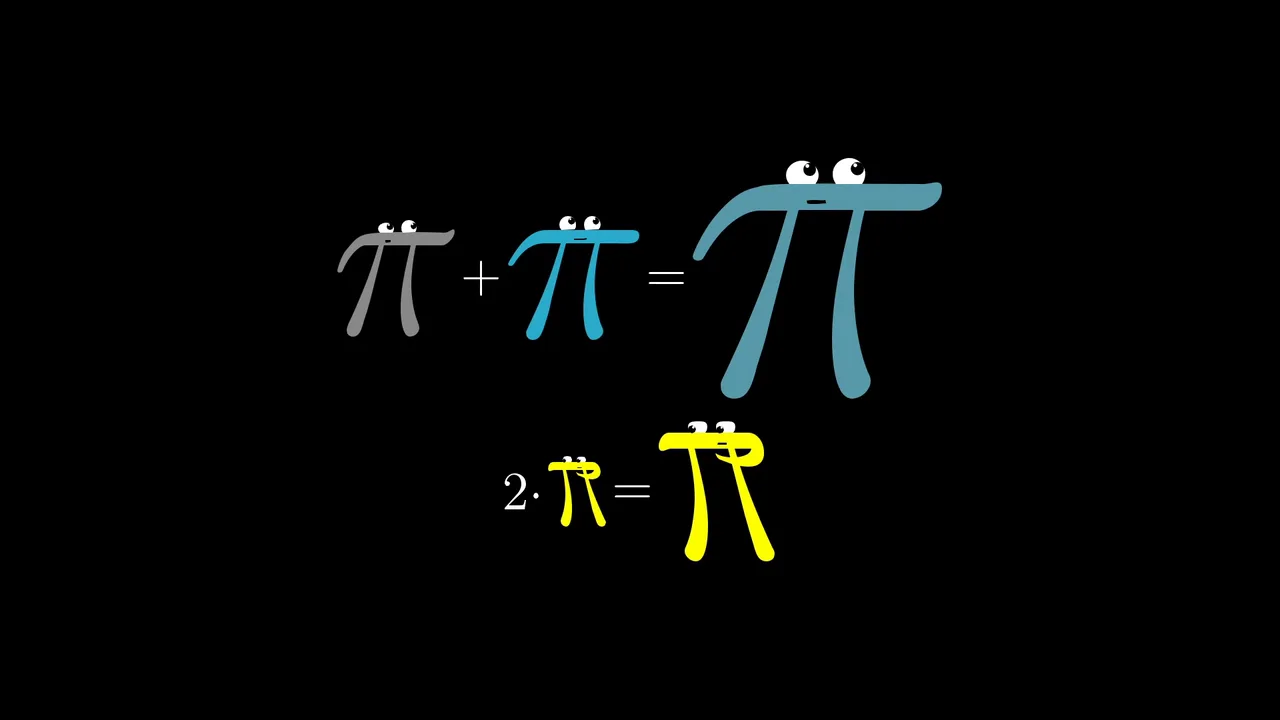
一句话直觉:向量究竟是什么并不重要——无论是箭头、数组、函数甚至“π生物”,只要定义在集合上的加法和数乘满足 8 条向量空间公理,整套线性代数大厦便能原封不动地适用。

作为《线性代数的本质》全系列收官之章,本章回答第 1 集提出的终极哲学之问:“向量到底是什么?”我们将目光从平面箭头转向微积分中的函数空间,用无限阶矩阵表示求导算子,从而揭示“可加性与成比例”为何能脱离网格而独立存在,并阐明现代数学如何借助八条公理筑起一座统摄万物的抽象“接口”。

▶ YouTube 原片 📺 B站官方双语 P15 🎙 B站中文配音 P15

前置依赖

← 第 01 集 · 向量究竟是什么?:重温全系列开篇“向量是物理箭头还是数字列表”的悬念,在终章完成思想闭环。
← 第 09 集 · 基变换:基变换让我们深刻体会到坐标依赖人为选基,空间本身独立于坐标之外。
← 第 10 集 · 特征向量与特征值:行列式与特征向量是内在的空间性质,且将在函数空间中对应为特征函数等核心概念。

后续延伸

本集为系列收官/拓展总结,建议前往 全系列速查表 复习。
线性变换的严格抽象定义(可加性与齐次性)
$$\begin{aligned} L(\vec{v} + \vec{w}) &= L(\vec{v}) + L(\vec{w}) \quad\text{(可加性 Additivity)} \\ L(c\vec{v}) &= c\,L(\vec{v}) \quad\text{(成比例 / 齐次性 Scaling)} \end{aligned}$$
多项式空间的幂基坐标映射
$$a_0 + a_1 x + a_2 x^2 + \cdots + a_n x^n \;\longleftrightarrow\; \begin{bmatrix} a_0 & a_1 & a_2 & \cdots & a_n & 0 & \cdots \end{bmatrix}^T$$
多项式空间中求导算子的无限矩阵表示
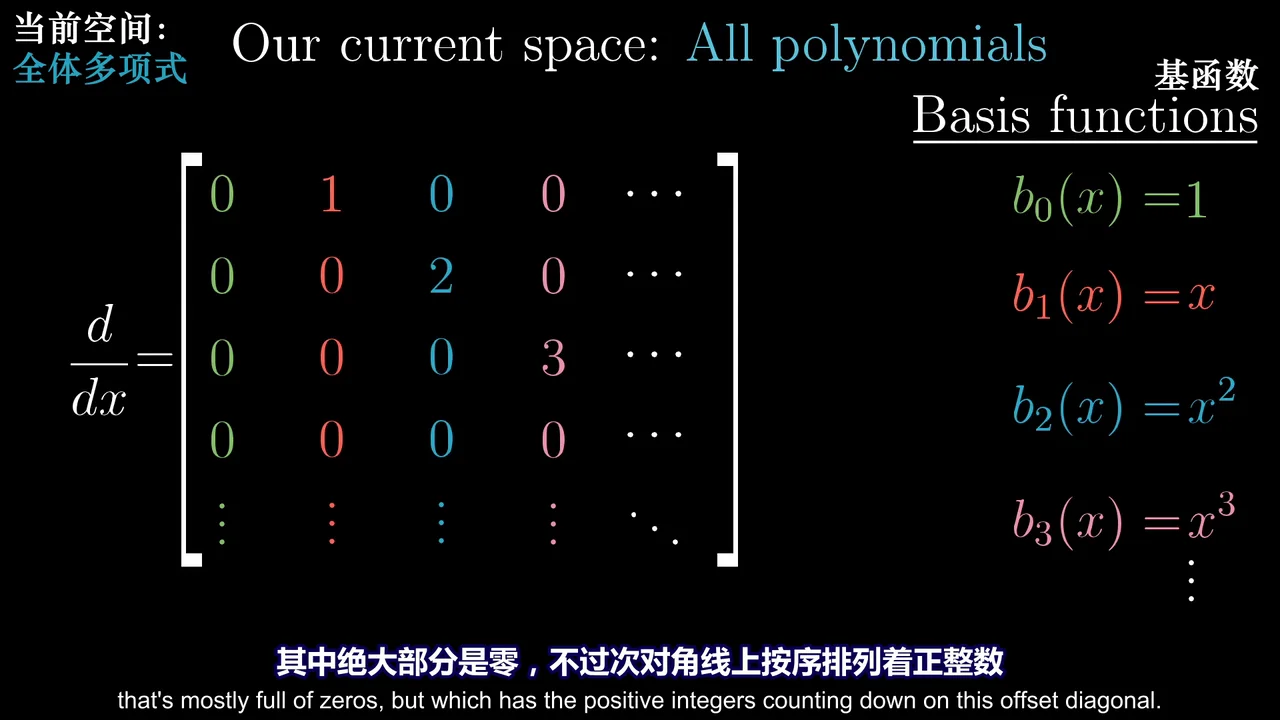
$$\frac{d}{dx} \;\longleftrightarrow\; \begin{bmatrix} 0 & 1 & 0 & 0 & \cdots \\ 0 & 0 & 2 & 0 & \cdots \\ 0 & 0 & 0 & 3 & \cdots \\ 0 & 0 & 0 & 0 & \cdots \\ \vdots & \vdots & \vdots & \vdots & \ddots \end{bmatrix}$$
求导算子矩阵作用于具体多项式坐标
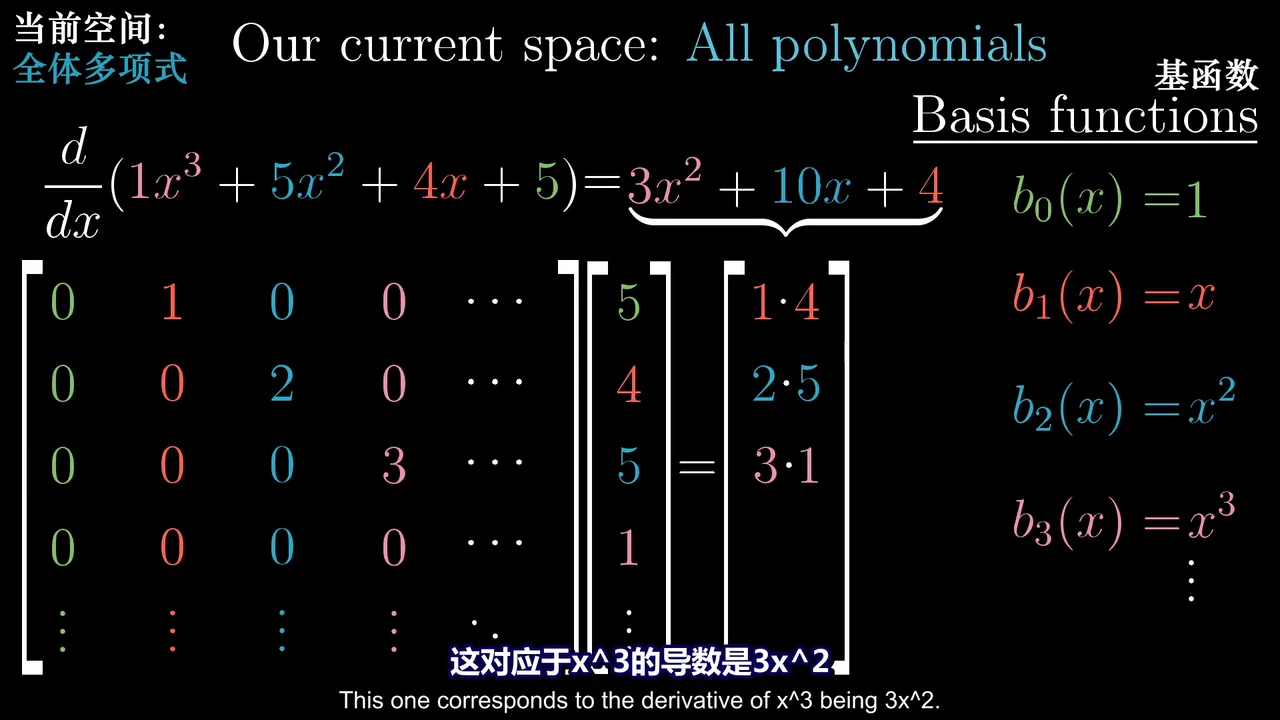
$$\frac{d}{dx}\begin{bmatrix} 5 \\ 4 \\ 5 \\ 1 \\ 0 \\ \vdots \end{bmatrix} = \begin{bmatrix} 4 \\ 10 \\ 3 \\ 0 \\ 0 \\ \vdots \end{bmatrix} \quad\Longleftrightarrow\quad \frac{d}{dx}(x^3 + 5x^2 + 4x + 5) = 3x^2 + 10x + 4$$

重温终极追问:向量究竟是箭头、数组还是空间?

⏱ 00:17 – 02:02

回到第 1 集开篇那个看似简单的问题:“向量究竟是什么?”二维向量本质上是平面内带坐标的箭头,还是恰好能画成箭头的一对实数?抑或两者都只是更深层事物的表象?

把向量看作“数字列表”固然清晰明确,让四维、一百维向量显得具体可操作(免得只能对着空气比划高维几何)。然而一旦熟练掌握基变换,人们就会产生强烈共鸣:坐标其实相当任意,完全取决于碰巧选了哪组基;而行列式(面积缩放)和特征向量(留在自身张成直线)却丝毫不受坐标系切换影响,是纯粹内蕴的“空间性(spatial)”性质。这就逼问着我们:数学家口中的“空间”究竟意味着什么?
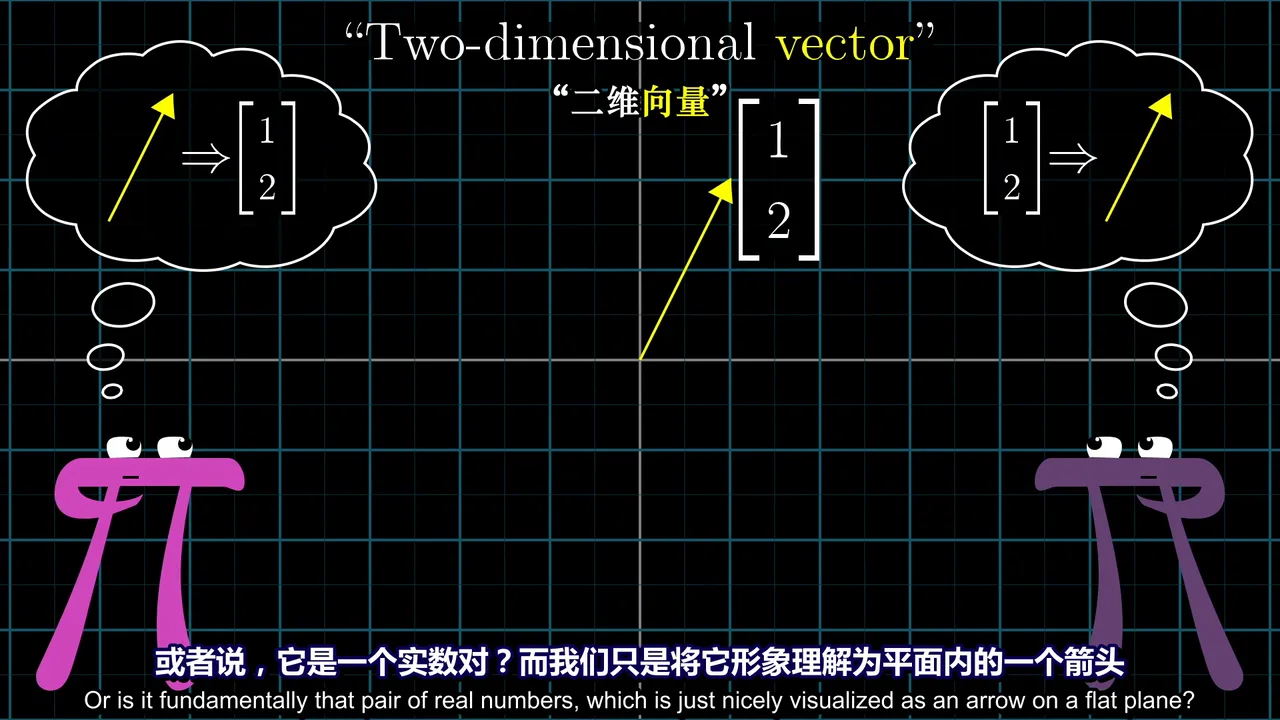
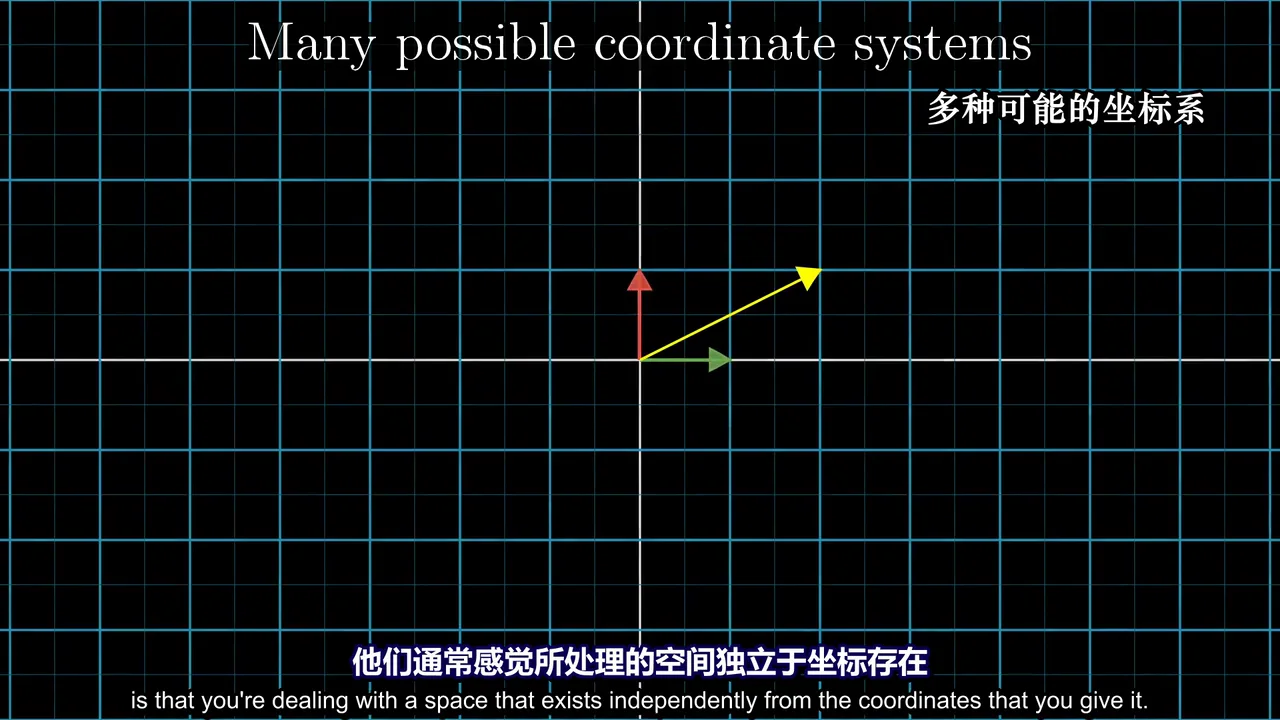
重温系列第一问:向量本质上是平面中的箭头,还是一组实数?(双视角对照) 00:33
重温系列第一问:向量本质上是平面中的箭头,还是一组实数?(双视角对照)画面重点:回归开篇核心哲学命题
来回切换不同坐标系,体会空间自身独立于人为选定的坐标之外 01:15
来回切换不同坐标系,体会空间自身独立于人为选定的坐标之外画面重点:坐标任意性与空间独立性
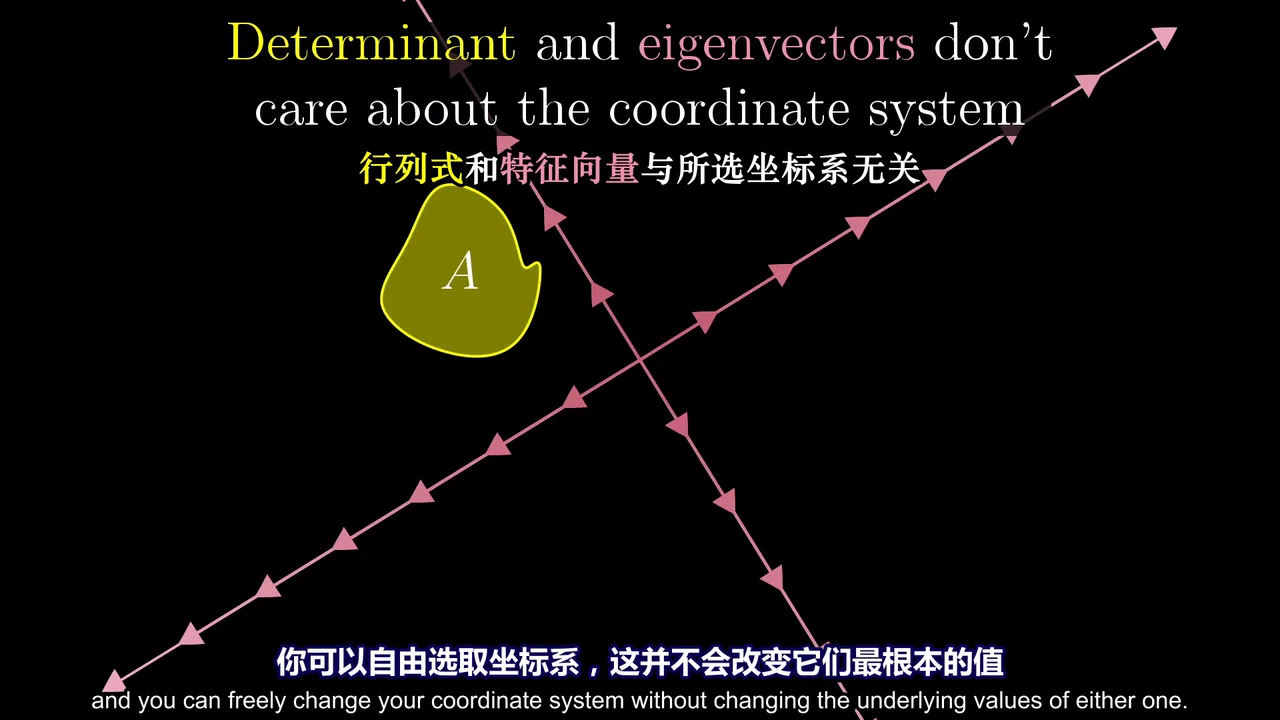
行列式与特征向量是不随坐标选取改变的内在空间性质 01:43
行列式与特征向量是不随坐标选取改变的内在空间性质画面重点:引出何为“空间”的终极定义
[00:17] ↗
我想重新探讨这个系列第一期视频中的一个看似简单的问题
I'd like to revisit a deceptively simple question that I asked in the very first video of this series.
[00:23] ↗
“向量是什么?”
What are vectors?
[00:24] ↗
比如说一个二维向量 从根本上说,它是平面内的一个箭头?而为了方便起见,我们用坐标来描述它
Is a two-dimensional vector, for example, fundamentally an arrow on a flat plane that we can describe with coordinates for convenience?
[00:31] ↗
或者说,它是一个实数对?而我们只是将它形象理解为平面内的一个箭头
Or is it fundamentally that pair of real numbers which is just nicely visualized as an arrow on a flat plane?
[00:38] ↗
又或者,这两种观点只是更深层次的东西的体现?
Or are both of these just manifestations of something deeper?
[00:42] ↗
一方面,将向量解释为一组数字给人感觉清晰明了
On the one hand, defining vectors as primarily being a list of numbers feels clear-cut and unambiguous.
[00:49] ↗
四维向量或者一百维向量看上去就像是可以操作的真实具体的概念
It makes things like four-dimensional vectors or 100-dimensional vectors sound like real, concrete ideas that you can actually work with.
[00:56] ↗
与之相反,四维空间之类的东西只是一个模糊的几何概念 不用手比划一下是很难解释清楚的
When otherwise, an idea like four dimensions is just a vague geometric notion that's difficult to describe without waving your hands a bit.
[01:06] ↗
但是另一方面,对于那些在实践中运用线性代数的人,尤其是熟悉基变换的人来说 他们通常感觉所处理的空间独立于坐标存在 而且坐标描述实际上有些随意 因为它依赖于你所选的基向量
But on the other hand, a common sensation for those who actually work with linear algebra, especially as you get more fluent with changing your basis, is that you're dealing with a space that exists independently from the coordinates that you give it, and that coordinates are actually somewhat arbitrary, depending on what you happen to choose as your basis vectors.
[01:24] ↗
线性代数中的核心话题,如行列式和特征向量等 它们似乎不受所选坐标系影响
Core topics in linear algebra, like determinants and eigenvectors, seem indifferent to your choice of coordinate systems.
[01:31] ↗
行列式告诉你的是一个变换对面积的缩放比例 特征向量则是在变换中留在它所张成的空间中的向量
The determinant tells you how much a transformation scales areas, and eigenvectors are the ones that stay on their own span during a transformation.
[01:40] ↗
这二者都是暗含于空间中的性质 你可以自由选取坐标系,这并不会改变它们最根本的值
But both of these properties are inherently spatial, and you can freely change your coordinate system without changing the underlying values of either one.
[01:51] ↗
但是,如果向量根本上并不是由一组实数构成 它们的本质其实更具空间性 这不禁让人产生疑问——那么数学家所说的“空间”或“空间性”是什么意思?
But if vectors are not fundamentally lists of real numbers, and if their underlying essence is something more spatial, that just begs the question of what mathematicians mean when they use a word like space or spatial.

既非箭头也非数组:为什么函数也是“向量”?

⏱ 02:03 – 04:14

为了揭示答案,我们来考察一种既不是空间箭头也不是有限数组、却具备一切向量特质的数学对象——函数(Functions):

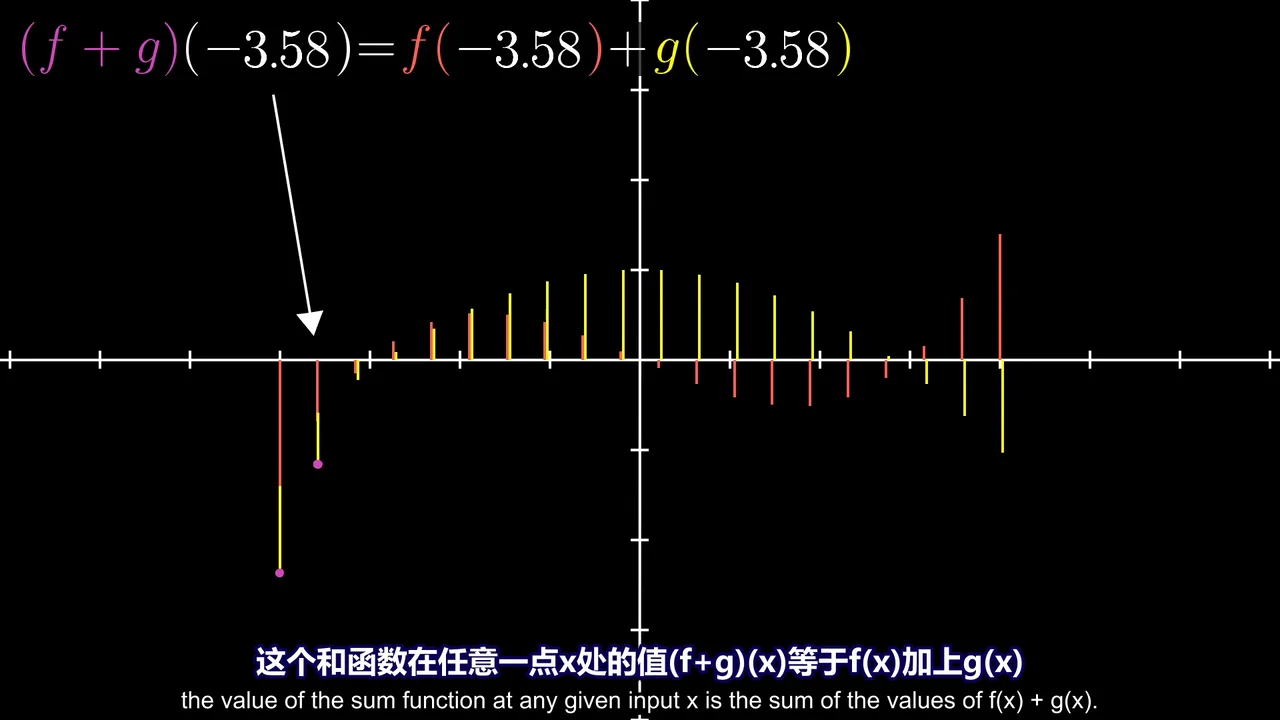
  • 函数相加:类比向量按分量相加,我们可以把两个函数 $f, g$ 相加得到新函数 $(f+g)$,其在任意输入(如 $-4$ 或一般自变量 $x$)的值等于对应输出之和 $(f+g)(x) = f(x) + g(x)$——就像拥有“无穷多个坐标”在逐点相加。
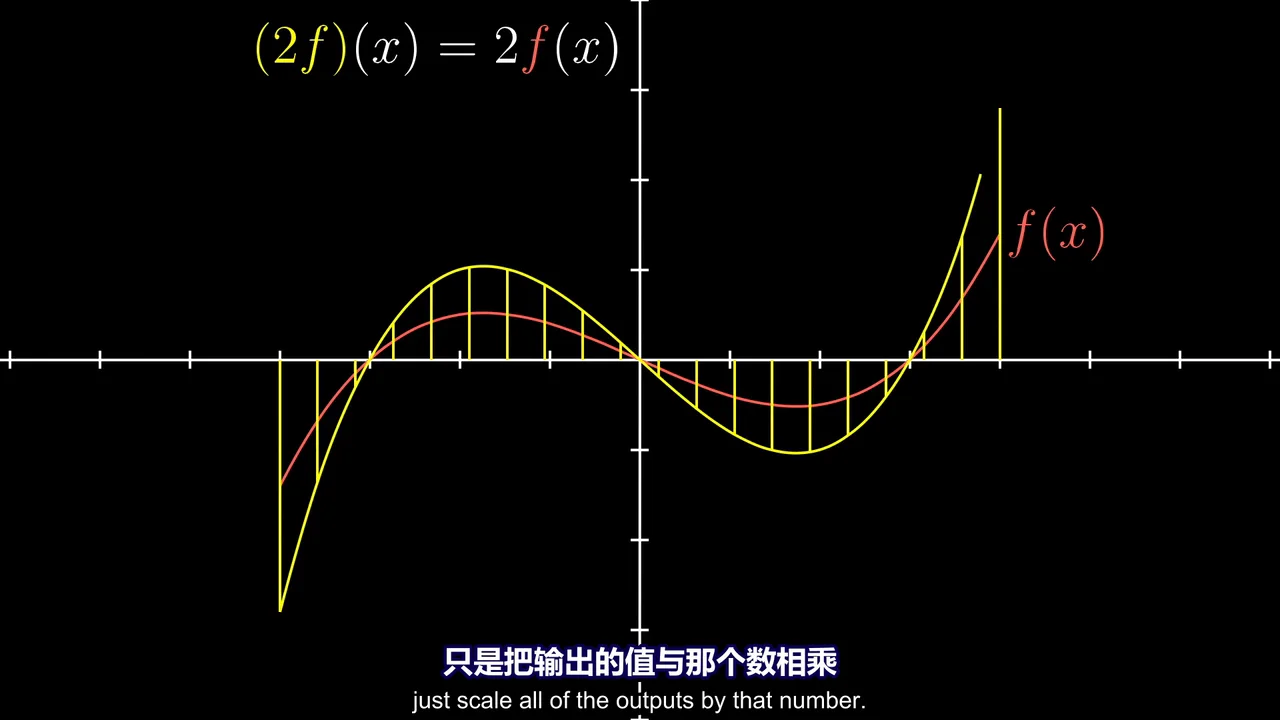
  • 函数数乘:用任意实数 $c$ 缩放函数,等价于将所有输出值一律乘以 $c$,即 $(cf)(x) = c\,f(x)$。
💡 微积分导数就是函数空间里的“线性算子”
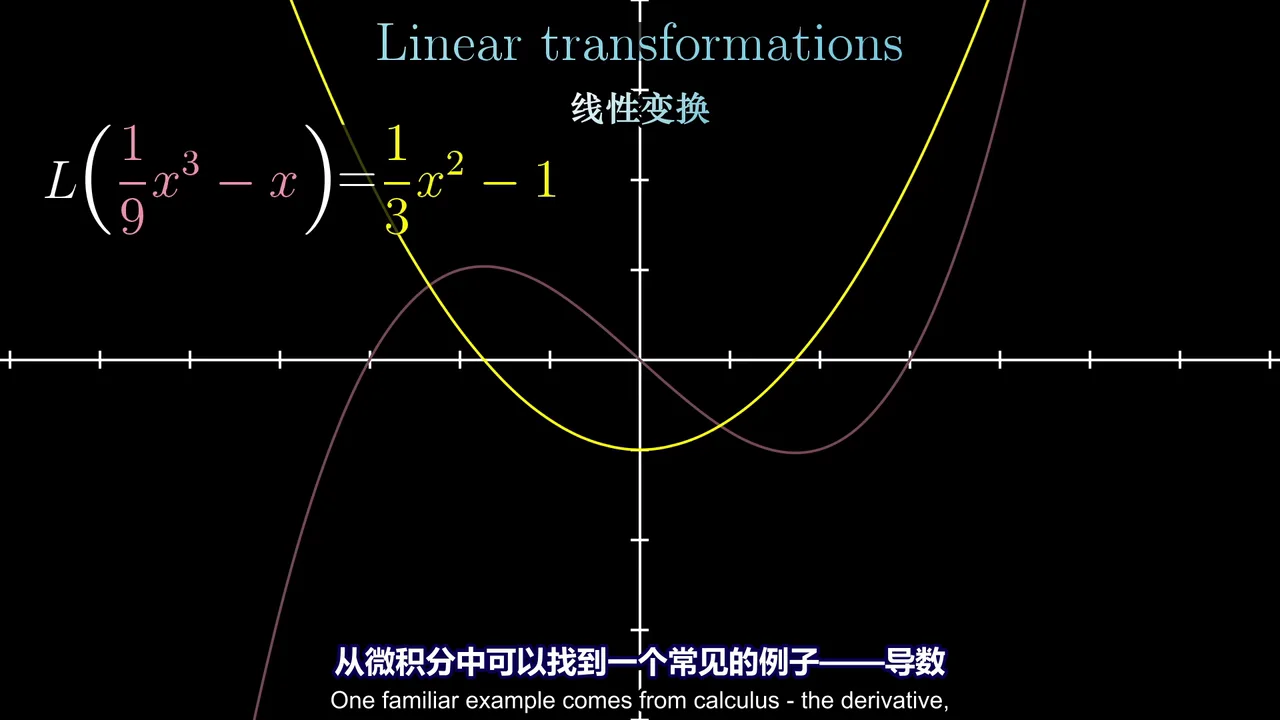
既然向量能做的操作无非“相加”与“数乘”,那么最初在箭头世界里锤炼出的全套线性代数工具,也应该原封不动地适用于函数!微积分中最熟悉的求导(derivative)就是一个吃进一个函数、吐出另一个函数的变换——在函数语境下常被称为算子(operator),本质与线性变换无异。
函数逐点相加演示:(f+g)(-3.58) = f(-3.58) + g(-3.58),类比无穷多坐标相加 02:48
函数逐点相加演示:(f+g)(-3.58) = f(-3.58) + g(-3.58),类比无穷多坐标相加画面重点:函数加法的几何与代数对应
函数数乘缩放:把函数在每一点的输出按统一标量拉伸或压缩 03:16
函数数乘缩放:把函数在每一点的输出按统一标量拉伸或压缩画面重点:函数数乘运算定义
微积分导数作为“算子”:输入函数曲线,输出导函数曲线 04:02
微积分导数作为“算子”:输入函数曲线,输出导函数曲线画面重点:连接微积分与线性代数
[02:03] ↗
为了进一步说说这是怎么回事 这期视频的大部分时间里 我会讨论一种既不是一个箭头也不是一组数字,但是同样具有向量特性的东西 函数
To build up to where this is going, I'd actually like to spend the bulk of this video talking about something which is neither an arrow nor a list of numbers, but also has vector-ish qualities – functions.
[02:14] ↗
从某种意义上说,函数实际上只是另一种向量
You see, there's a sense in which functions are actually just another type of vector.
[02:20] ↗
类比两个向量相加的方法 我们也可以将两个函数f和g相加,从而获得一个新函数(f+g),这种做法是合理的
In the same way that you can add two vectors together, there's also a sensible notion for adding two functions, f and g, to get a new function, f plus g.
[02:28] ↗
你可能已经知道它的结果了,但是真的把它叙述出来还是挺拗口的
It's one of those things where you kind of already know what it's going to be, but actually phrasing it is a mouthful.
[02:34] ↗
这个新函数在任意一点处的值,比如说在-4处的值 就是f和g在这一点处(即-4)的值的和
The output of this new function at any given input, like negative four, is the sum of the outputs of f and g when you evaluate them each at that same input, negative four.
[02:45] ↗
更一般地说 这个和函数在任意一点x处的值(f+g)(x)等于f(x)加上g(x)
Or more generally, the value of the sum function at any given input x is the sum of the values f of x plus g of x.
[03:01] ↗
这和向量对应坐标相加非常相似 只不过在某种程度上说,它有无穷多个坐标要相加
This is pretty similar to adding vectors coordinate by coordinate, it's just that there are, in a sense, infinitely many coordinates to deal with.
[03:11] ↗
类似地,函数与一个实数相乘也有合理的解释 只是把输出的值与那个数相乘
Similarly, there's a sensible notion for scaling a function by a real number, just scale all of the outputs by that number.
[03:20] ↗
这再次和向量对应坐标数乘类似 只是感觉上有无穷多个坐标要数乘
And again, this is analogous to scaling a vector coordinate by coordinate, it just feels like there's infinitely many coordinates.
[03:29] ↗
因为对向量所能进行的操作不过相加和数乘两种 所以,最初以空间中的箭头为背景考虑的线性代数的合理概念和解决问题的手段 应该能够原封不动地被我们取出来 然后应用于函数
Now, given that the only thing vectors can really do is get added together or scaled, it feels like we should be able to take the same useful constructs and problem solving techniques of linear algebra that were originally thought about in the context of arrows and space and apply them to functions as well.
[03:47] ↗
举个例子,函数的线性变换有一个完全合理的解释 这个变换接收一个函数,并把它变成另一个函数
For example, there's a perfectly reasonable notion of a linear transformation for functions, something that takes in one function and turns it into another.
[04:00] ↗
从微积分中可以找到一个常见的例子——导数
One familiar example comes from calculus, the derivative.
[04:03] ↗
它将一个函数变换到另一个函数
It's something which transforms one function into another function.
[04:09] ↗
关于这点,有时你听到的是“算子”而不是“变换” 不过它们的意思一样
Sometimes in this context you'll hear these called operators instead of transformations, but the meaning is the same.

线性的严格定义:可加性与成比例(齐次性)

⏱ 04:16 – 06:47

函数没有二维平面上的“网格线”,所以不能再用“网格线保持平行且等距”来判断线性。为此,数学给出了更抽象却高度普适的符号定义——一个变换(或算子) $L$ 是线性的,当且仅当它同时满足两条性质(即保持向量加法与数乘运算):

📐 线性变换的通用公理化定义
$$\text{可加性:} L(\vec{v} + \vec{w}) = L(\vec{v}) + L(\vec{w}), \qquad \text{成比例:} L(c\vec{v}) = c\,L(\vec{v})$$
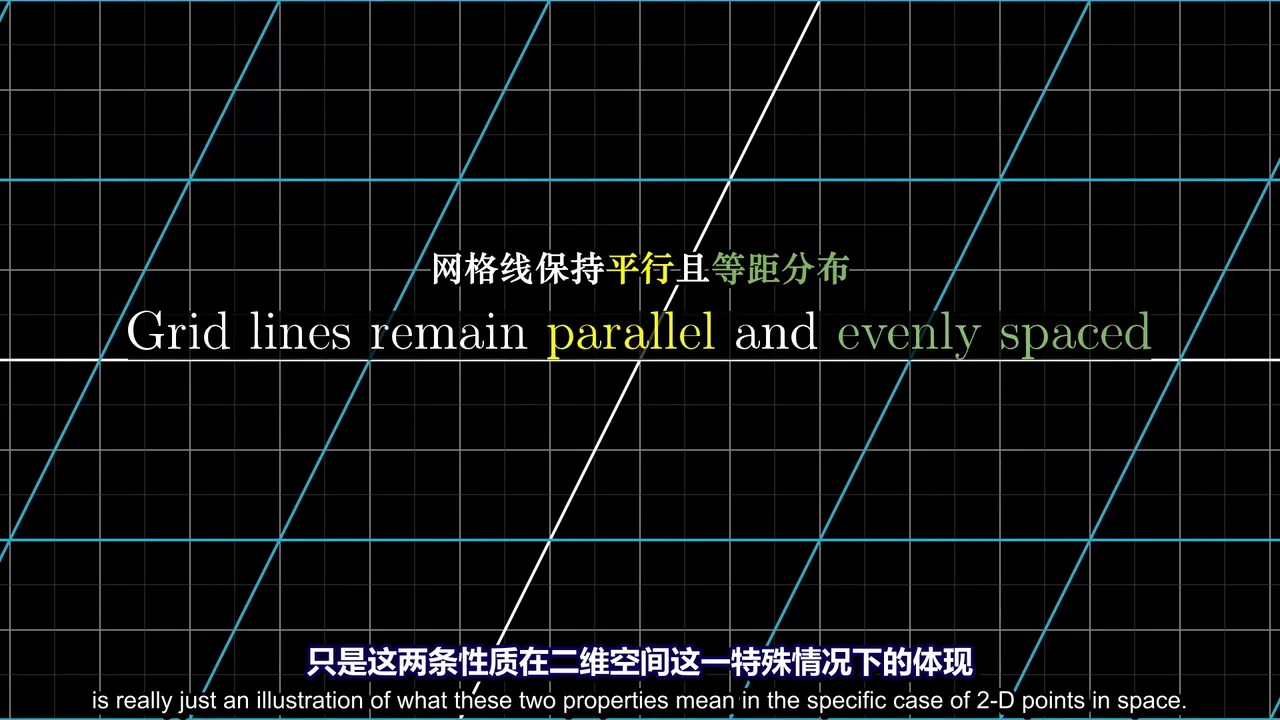
第 3 章的“网格线保持平行且等距”只是这两条抽象规则在二维平面点集特例下的几何显影。

这两条性质带来了一个极核心的推论:线性变换依然完全由它对基向量的作用决定(因为任意向量都是基的线性组合)。而微积分里的求导天然满足这两条规则:和的导数等于导数之和 $(f+g)' = f'+g'$,数乘的导数等于先求导再数乘 $(cf)' = c\,f'$——所以求导算子是严格线性的!
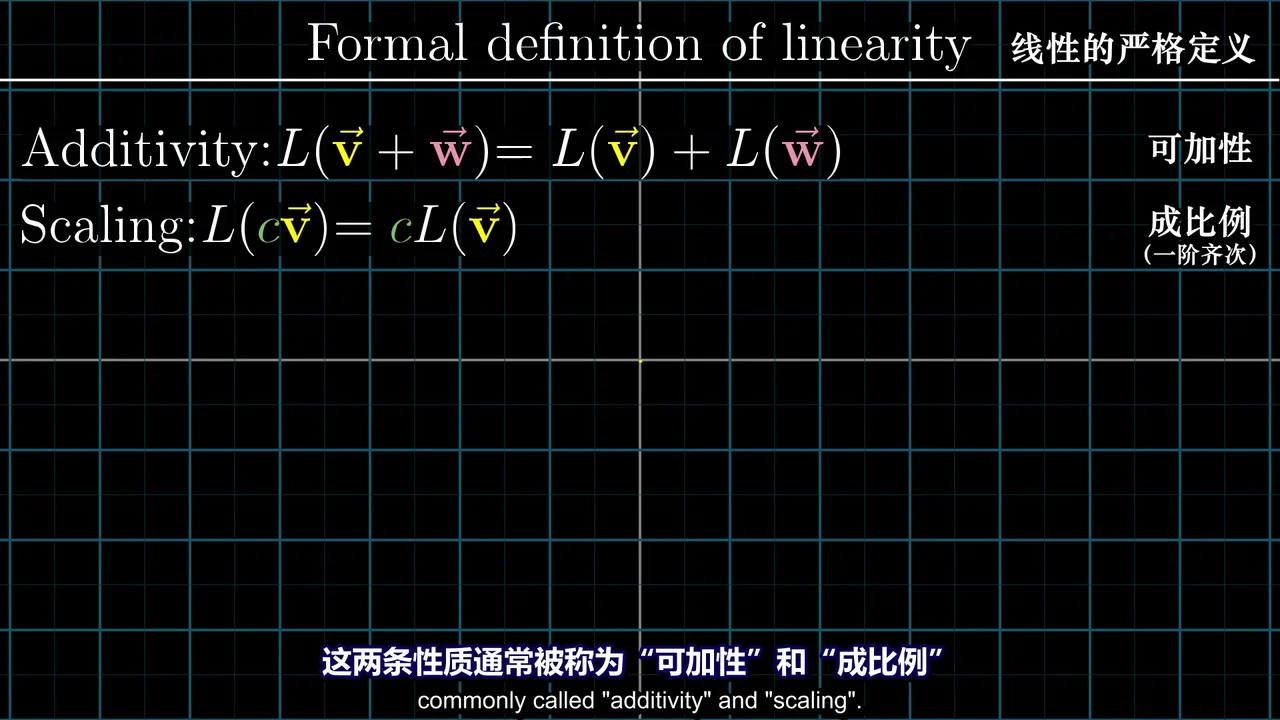
屏幕上列出线性变换的严格符号定义:可加性 L(v+w)=L(v)+L(w) 与成比例 L(cv)=cL(v) 04:44
屏幕上列出线性变换的严格符号定义:可加性 L(v+w)=L(v)+L(w) 与成比例 L(cv)=cL(v)画面重点:从几何直觉上升到抽象符号定义
将抽象定义对照二维网格:网格平行且等距正是两条代数性质的平面特例 05:38
将抽象定义对照二维网格:网格平行且等距正是两条代数性质的平面特例画面重点:新旧线性定义深度打通
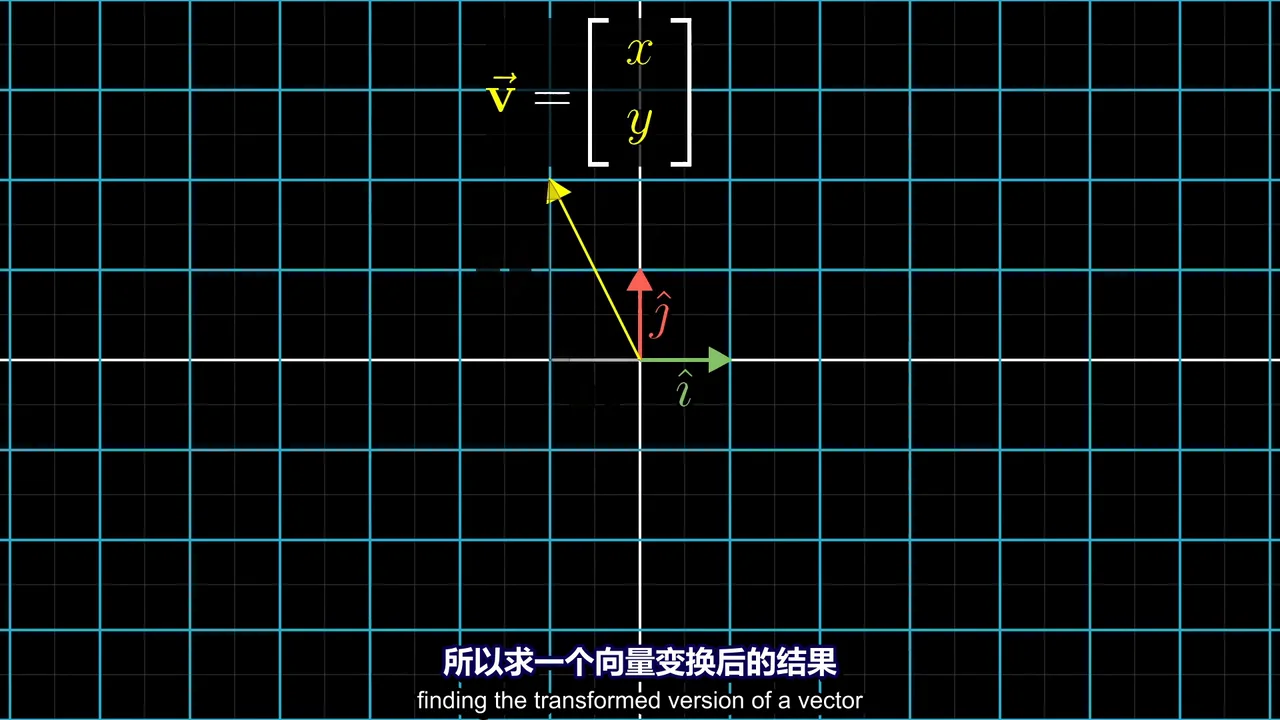
线性性推论:由基向量的像通过同样线性组合决定任意向量的像 06:03
线性性推论:由基向量的像通过同样线性组合决定任意向量的像画面重点:矩阵表示得以成立的基石
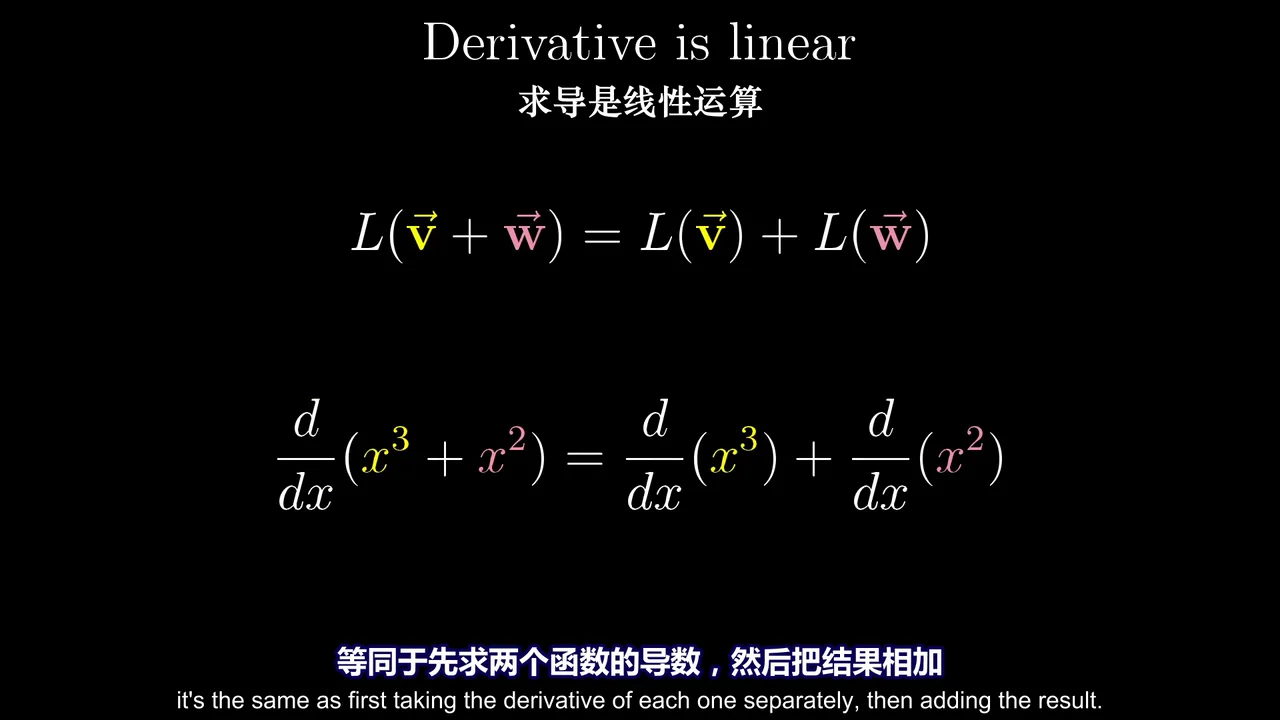
验证微积分求导满足可加性与成比例,正式确认求导是线性算子 06:33
验证微积分求导满足可加性与成比例,正式确认求导是线性算子画面重点:导数算子的线性性证明
[04:16] ↗
你自然想问,“一个函数变换是线性的”是什么意思
A natural question you might want to ask is what it means for a transformation of functions to be linear.
[04:22] ↗
相比于我在这个系列的第三章视频中讨论的定义方法 线性的严格定义是相对抽象而符号繁重的
The formal definition of linearity is relatively abstract and symbolically driven compared to the way that I first talked about it in chapter 3 of this series.
[04:30] ↗
但是,抽象性带来的好处是我们能得到一般性的结论 它不仅适用于箭头,也适用于函数
But the reward of abstractness is that we'll get something general enough to apply to functions as well as arrows.
[04:39] ↗
满足以下两条性质的变换是线性的 这两条性质通常被称为“可加性”和“成比例”
A transformation is linear if it satisfies two properties, commonly called additivity and scaling.
[04:46] ↗
可加性意味着如果你把两个向量v和w相加,然后对它们的和应用变换 得到的结果和将变换后的v与变换后的w相加一致
Additivity means that if you add two vectors, v and w, then apply a transformation to their sum, you get the same result as if you added the transformed versions of v and w.
[05:05] ↗
成比例是说,你将一个向量v与某个数相乘 然后应用变换 得到的结果和变换后的v与这个数相乘一致
The scaling property is that when you scale a vector v by some number, then apply the transformation, you get the same ultimate vector as if you scaled the transformed version of v by that same amount.
[05:22] ↗
你经常会听到的一种描述方法是“线性变换保持向量加法运算和数乘运算”
The way you'll often hear this described is that linear transformations preserve the operations of vector addition and scalar multiplication.
[05:32] ↗
我在前几期视频中讨论过的网格线保持平行且等距分布的概念 只是这两条性质在二维空间这一特殊情况下的体现
The idea of gridlines remaining parallel and evenly spaced that I've talked about in past videos is really just an illustration of what these two properties mean in the specific case of points in 2D space.
[05:45] ↗
这两条性质的一个最重要的推论是 一个线性变换可以通过它对基向量的作用来完全描述,这使得矩阵向量乘法成为可能
One of the most important consequences of these properties, which makes matrix vector multiplication possible, is that a linear transformation is completely described by where it takes the basis vectors.
[05:58] ↗
因为任一向量都能表达为基向量以某种方式进行线性组合 所以求一个向量变换后的结果 实际上就是求出变换后的基向量以相同方式进行线性组合的结果
Since any vector can be expressed by scaling and adding the basis vectors in some way, finding the transformed version of a vector comes down to scaling and adding the transformed versions of the basis vectors in that same way.
[06:12] ↗
稍后你就会明白,跟箭头一样,这一点对函数来说同样正确
As you'll see in just a moment, this is as true for functions as it is for arrows.
[06:18] ↗
比如说,学微积分的学生经常会用到一个事实 即求导具有可加性和成比例性 即便他们没有听过这种说法
For example, calculus students are always using the fact that the derivative is additive and has the scaling property, even if they haven't heard it phrased that way.
[06:28] ↗
如果你把两个函数相加,然后求导数 等同于先求两个函数的导数,然后把结果相加
If you add two functions, then take the derivative, it's the same as first taking the derivative of each one separately, then adding the result.
[06:40] ↗
类似地,如果你将函数与数相乘,然后求导数 等同于先求导数,然后把结果与数相乘
Similarly, if you scale a function, then take the derivative, it's the same as first taking the derivative, then scaling the result.

把求导写成无限阶矩阵:多项式空间实战

⏱ 06:50 – 11:27

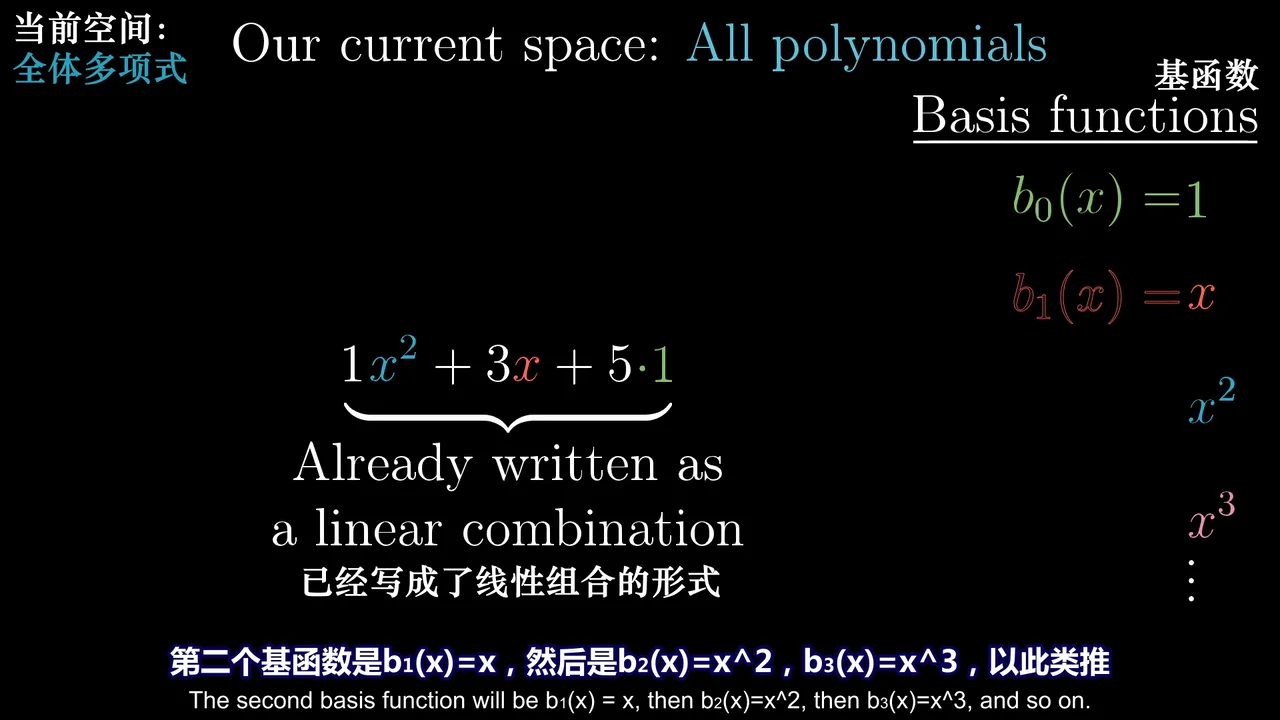
虽然一般函数空间往往是无穷维的,我们依然可以挑出全体多项式(任意高次但每一项均有限)来体验“用矩阵表示求导”。先选取自然的一组无穷基函数:$b_0(x)=1$、$b_1(x)=x$、$b_2(x)=x^2$、$b_3(x)=x^3 \dots$ 于是每个多项式就化身为一列带有无限个尾零的坐标向量:

  • $1x^2 + 3x + 5\cdot 1 \longleftrightarrow \begin{bmatrix} 5 & 3 & 1 & 0 & 0 & \cdots \end{bmatrix}^T$
  • $4x^7 - 5x^2 \longleftrightarrow \begin{bmatrix} 0 & 0 & -5 & 0 & 0 & 0 & 0 & 4 & 0 & \cdots \end{bmatrix}^T$

按老办法构造算子矩阵:对每个基函数求导($b_0'=0, b_1'=1, b_2'=2x, b_3'=3x^2 \dots$)并把结果坐标作为矩阵的各列,就得到一个在次对角线上排列着正整数 $1, 2, 3, \dots$、其余全为零的无限阶矩阵!拿它乘以 $x^3 + 5x^2 + 4x + 5$ 的坐标 $\begin{bmatrix} 5 & 4 & 5 & 1 & 0 & \cdots \end{bmatrix}^T$:第 1 行算出 $1\times 4 = 4$,第 2 行算出 $2\times 5 = 10$,第 3 行算出 $3\times 1 = 3$,完美输出导数 $3x^2 + 10x + 4$!
💡 箭头世界与函数世界的术语对照词典
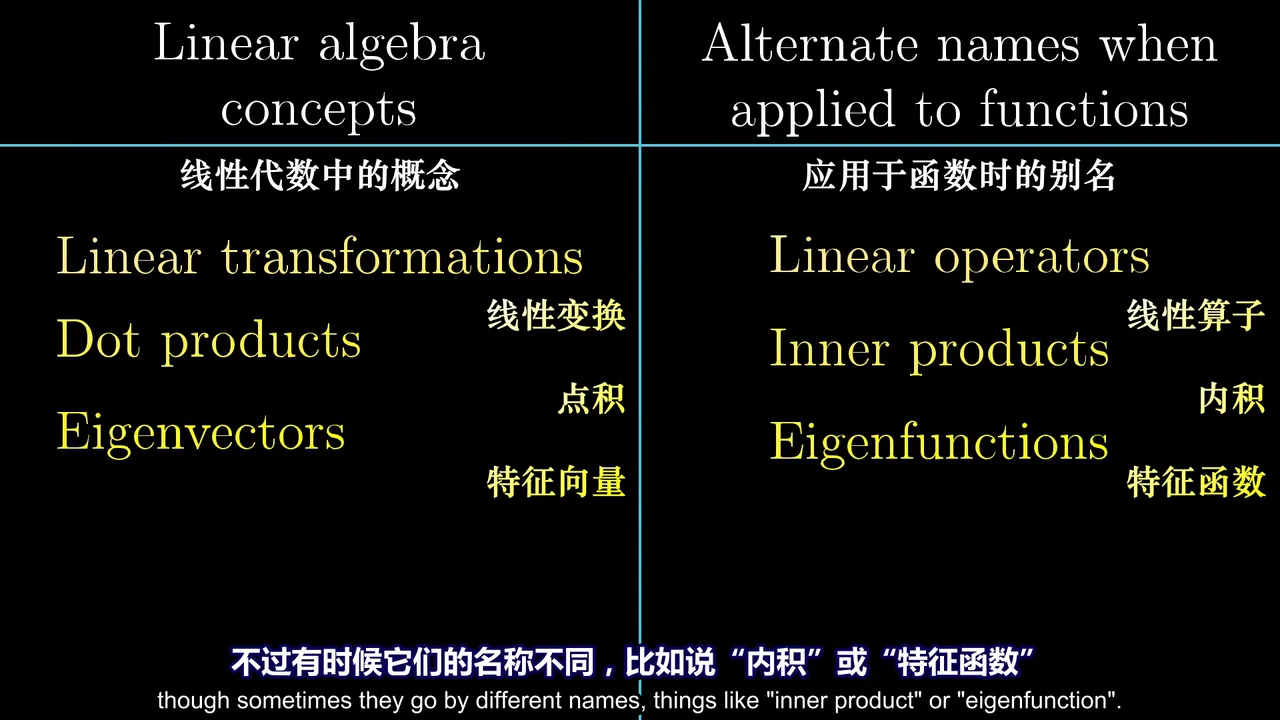
原来“矩阵乘向量”和“函数求导”本就是一家人!整个系列学到的所有核心概念在函数空间都有直接化身,只是有时改换了名称:点积 $\longleftrightarrow$ 内积(inner product),特征向量 $\longleftrightarrow$ 特征函数(eigenfunction)(例如 $e^{kx}$ 就是求导算子的特征函数)。
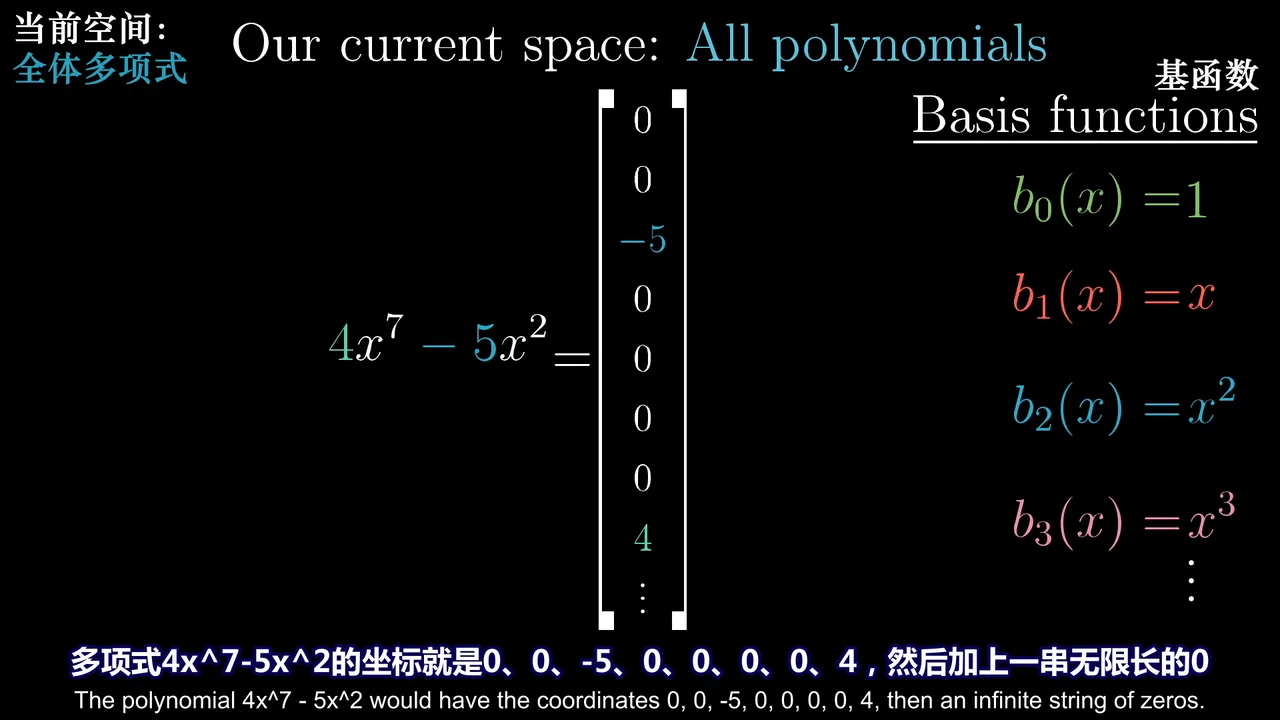
限定空间为全体多项式,选取幂函数 1, x, x^2, x^3... 作无穷基函数并写出坐标 07:45
限定空间为全体多项式,选取幂函数 1, x, x^2, x^3... 作无穷基函数并写出坐标画面重点:函数空间如何建立坐标系
七次多项式 4x^7 - 5x^2 转换为坐标向量 [0, 0, -5, 0, 0, 0, 0, 4, 0, ...]^T 08:46
七次多项式 4x^7 - 5x^2 转换为坐标向量 [0, 0, -5, 0, 0, 0, 0, 4, 0, ...]^T画面重点:有限项多项式的无限尾零坐标
展示无限阶求导矩阵 d/dx:仅次对角线依次排列正整数 1, 2, 3...,其余皆为 0 09:14
展示无限阶求导矩阵 d/dx:仅次对角线依次排列正整数 1, 2, 3...,其余皆为 0画面重点:求导算子的矩阵真容
矩阵向量乘法实算:(x^3+5x^2+4x+5)' 完整算出三项系数 [1·4; 2·5; 3·1] 即 3x^2+10x+4 10:22
矩阵向量乘法实算:(x^3+5x^2+4x+5)' 完整算出三项系数 [1·4; 2·5; 3·1] 即 3x^2+10x+4画面重点:矩阵乘法与微积分求导完全等价
概念跨界映射表:线性变换↔线性算子,点积↔内积,特征向量↔特征函数 11:25
概念跨界映射表:线性变换↔线性算子,点积↔内积,特征向量↔特征函数画面重点:线性代数工具向无限维函数域全面迁移
[06:50] ↗
为了真正掌握这里的类比关系,我们来看看用矩阵描述求导是什么样子的
To really drill in the parallel, let's see what it might look like to describe the derivative with a matrix.
[06:57] ↗
这可能有些棘手,因为函数空间倾向于有无穷维 不过我觉得这个练习实际上很符合要求
This will be a little tricky, since function spaces have a tendency to be infinite dimensional, but I think this exercise is actually quite satisfying.
[07:05] ↗
我们现在把目光限制在多项式空间上,比如说x^2+3x+5或者4x^7-5x^2等等
Let's limit ourselves to polynomials, things like x squared plus 3x plus 5, or 4x to the seventh minus 5x squared.
[07:12] ↗
虽然这个空间中的每一个多项式都只有有限项 但是整个空间应该包含任意高次的多项式
Each of the polynomials in our space will only have finitely many terms, but the full space is going to include polynomials with arbitrarily large degree.
[07:22] ↗
首先我们要做的是给这个空间赋予坐标的含义,这需要选取一个基
The first thing we need to do is give coordinates to this space, which requires choosing a basis.
[07:28] ↗
因为多项式已经是数乘x的不同次幂再做加和的形式 所以我们很自然地就取x的不同次幂作为基函数
Since polynomials are already written down as the sum of scaled powers of the variable x, it's pretty natural to just choose pure powers of x as the basis function.
[07:38] ↗
换句话说,第一个基函数就是一个常函数,即b0(x)=1
In other words, our first basis function will be the constant function, b0 of x equals 1.
[07:44] ↗
第二个基函数是b1(x)=x,然后是b2(x)=x^2,b3(x)=x^3,以此类推
The second basis function will be b1 of x equals x, then b2 of x equals x squared, then b3 of x equals x cubed, and so on.
[07:54] ↗
基函数在这里起到的作用 和i帽、j帽和k帽在向量(箭头)的世界中起到的作用类似
The role that these basis functions serve will be similar to the roles of i-hat, j-hat, and k-hat in the world of vectors as arrows.
[08:02] ↗
因为多项式的次数可以任意高,所以这个基函数集也是无穷大的
Since our polynomials can have arbitrarily large degree, this set of basis functions is infinite.
[08:08] ↗
不过没有关系,这只是说明我们把多项式当向量来处理时 它们会有无穷多个坐标
But that's okay, it just means that when we treat our polynomials as vectors, they're going to have infinitely many coordinates.
[08:16] ↗
比如说多项式x^2+3x+5 用坐标来描述的话就是5、3、1,然后跟上无穷多个0
A polynomial like x squared plus 3x plus 5, for example, would be described with the coordinates 5, 3, 1, then infinitely many zeros.
[08:26] ↗
你可以这样理解它:5乘以第一个基函数 加上3乘以第二个基函数 加上1乘以第三个基函数 在此之后,其他基函数不再出现
You'd read this as saying that it's 5 times the first basis function, plus 3 times that second basis function, plus 1 times the third basis function, and then none of the other basis functions should be added from that point on.
[08:41] ↗
多项式4x^7-5x^2的坐标就是0、0、-5、0、0、0、0、4,然后加上一串无限长的0
The polynomial 4x to the seventh minus 5x squared would have the coordinates 0, 0, negative 5, 0, 0, 0, 0, 4, then an infinite string of zeros.
[08:53] ↗
总的来说,因为每一个多项式都只有有限项 所以它的坐标就是有限长的一串数,再跟上无限长的一串零
In general, since every individual polynomial has only finitely many terms, its coordinates will be some finite string of numbers with an infinite tail of zeros.
[09:07] ↗
在这个坐标系中,求导是用一个无限阶矩阵描述的 其中绝大部分是零,不过次对角线上按序排列着正整数
In this coordinate system, the derivative is described with an infinite matrix that's mostly full of zeros, but which has the positive integers counting down on this offset diagonal.
[09:18] ↗
我稍后会讨论一下你如何才能求出这个矩阵 不过熟悉它的最好方法是看看它的作用过程
I'll talk about how you could find this matrix in just a moment, but the best way to get a feel for it is to just watch it in action.
[09:25] ↗
取出多项式x^3+5x^2+4x+5的坐标 然后把它放在矩阵的右侧
Take the coordinates representing the polynomial x cubed plus 5x squared plus 4x plus 5, then put those coordinates on the right of the matrix.
[09:40] ↗
对结果的第一个坐标有贡献的只有1乘以4这一项 也就是说结果的常数项是4
The only term that contributes to the first coordinate of the result is 1 times 4, which means the constant term in the result will be 4.
[09:50] ↗
这对应于4x的导数是常数4
This corresponds to the fact that the derivative of 4x is the constant 4.
[09:56] ↗
对矩阵向量乘积的第二个坐标有贡献的只有2乘以5这一项 也就是说结果中x前的系数是10
The only term contributing to the second coordinate of the matrix vector product is 2 times 5, which means the coefficient in front of x in the derivative is 10.
[10:06] ↗
这对应于5x^2的导数(是10x)
That one corresponds to the derivative of 5x squared.
[10:11] ↗
与之类似,矩阵向量乘积的第三个坐标就是3乘以1
Similarly, the third coordinate in the matrix vector product comes down to taking 3 times 1.
[10:18] ↗
这对应于x^3的导数是3x^2
This one corresponds to the derivative of x cubed being 3x squared.
[10:23] ↗
在此之后的坐标都是零
And after that, it'll be nothing but zeros.
[10:27] ↗
求导满足线性性质使这一过程成为可能
What makes this possible is that the derivative is linear.
[10:32] ↗
而且对那些想要暂停思考一番的人来说 你可以用这种方法构建这个矩阵:求每一个基函数的导数,然后把结果放在对应列
And for those of you who like to pause and ponder, you could construct this matrix by taking the derivative of each basis function and putting the coordinates of the results in each column.
[11:00] ↗
出乎我们意料的是 乍一看,矩阵向量乘法和求导像是毫不相干的 但它们两个其实是一家人
So, surprisingly, matrix vector multiplication and taking a derivative, which at first seem like completely different animals, are both just really members of the same family.
[11:11] ↗
实际上,这个系列中我讨论过的大部分关于向量(空间中的箭头)的概念 比如说点积或特征向量 在函数的世界中都有直接的类比 不过有时候它们的名称不同,比如说“内积”或“特征函数”
In fact, most of the concepts I've talked about in this series with respect to vectors as arrows in space, things like the dot product or eigenvectors, have direct analogs in the world of functions, though sometimes they go by different names, things like inner product or eigenfunction.

八条向量空间公理:数学理论与应用的“标准接口”

⏱ 11:28 – 14:21

数学中还有数不清的“类向量对象”,构成的集合统称为向量空间(vector spaces)。为了使整套线性代数定理一次性通吃箭头、数组、函数甚至别人异想天开的“$\pi$ 生物集合”,现代数学确立了加法和数乘必须遵守的八条公理清单(8 axioms):

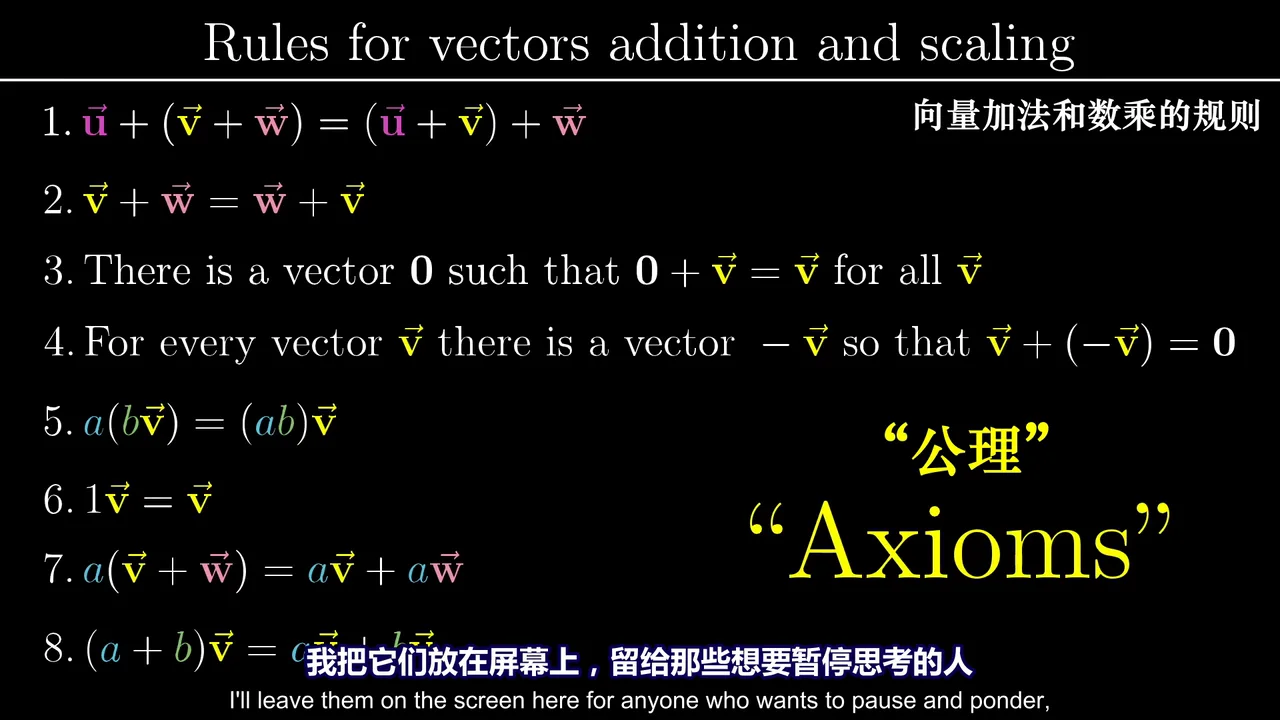
  • 1. 加法结合律:$\vec{u} + (\vec{v} + \vec{w}) = (\vec{u} + \vec{v}) + \vec{w}$
  • 2. 加法交换律:$\vec{v} + \vec{w} = \vec{w} + \vec{v}$
  • 3. 存在加法零元:存在 $\vec{0}$ 使对任意 $\vec{v}$ 有 $\vec{0} + \vec{v} = \vec{v}$
  • 4. 存在加法逆元:对每个 $\vec{v}$ 存在 $-\vec{v}$ 使 $\vec{v} + (-\vec{v}) = \vec{0}$
  • 5. 数乘与标量乘法相容:$a(b\vec{v}) = (ab)\vec{v}$
  • 6. 数乘单位元:$1\vec{v} = \vec{v}$
  • 7. 数乘对向量加法分配律:$a(\vec{v} + \vec{w}) = a\vec{v} + a\vec{w}$
  • 8. 数乘对标量加法分配律:$(a + b)\vec{v} = a\vec{v} + b\vec{v}$
💡 公理不是“自然法则”,而是“软件接口(Interface)”
这 8 条公理绝非什么神圣宇宙铁律,而是一份连接“证明定理的数学家”和“使用定理的应用者”的通用契约接口:应用者只需验证自己定义的新对象满足这 8 条清单,就能立刻白嫖全部线性代数定理;而数学家也只用基于公理推演,根本不用操心别人造了什么古怪向量空间——这正是所有现代教科书坚持从抽象公理与“可加性/成比例”写起的根本原因。
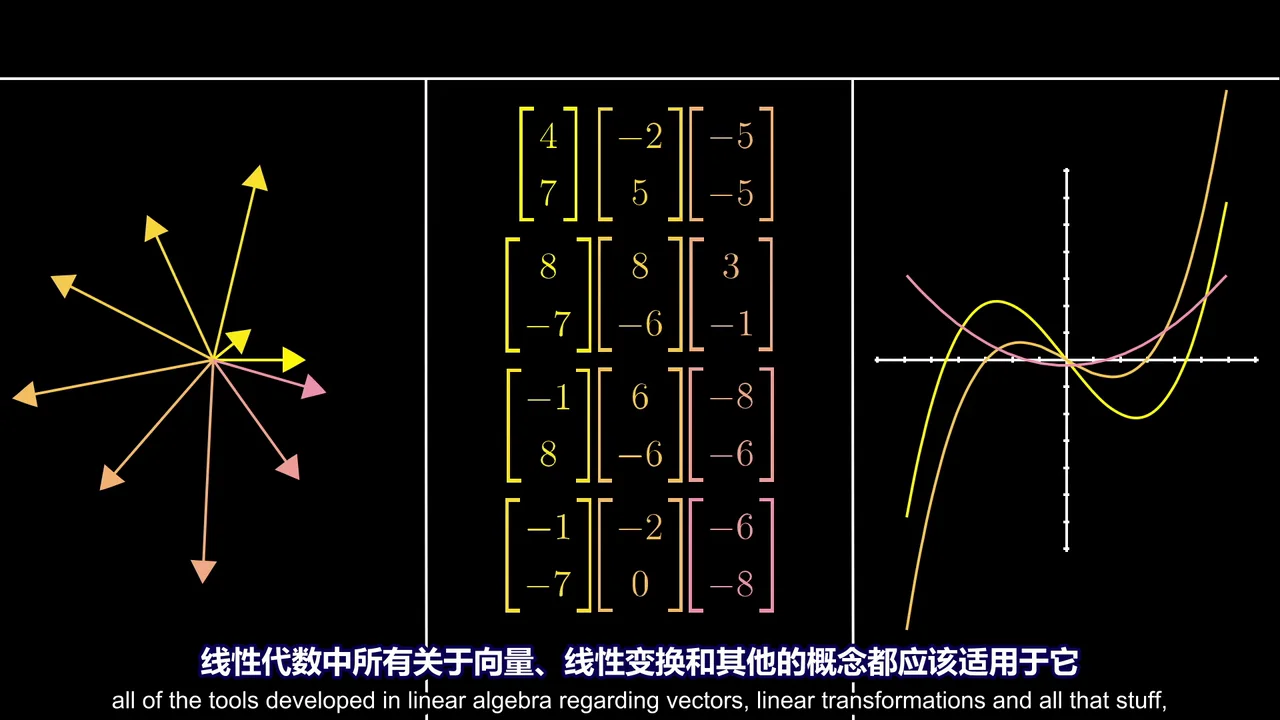
箭头、数字列表、函数等多重化身并列,引出“向量空间”统称 11:50
箭头、数字列表、函数等多重化身并列,引出“向量空间”统称画面重点:万物皆可为向量的抽象共性
屏幕完整展示现代线性代数中的 8 条向量空间公理清单 12:50
屏幕完整展示现代线性代数中的 8 条向量空间公理清单画面重点:向量加法与数乘必须满足的八条契约规则
幽默演示:即便有人定义“全体 π 生物的集合”,只要验证满足 8 条公理即可应用全部理论 13:20
幽默演示:即便有人定义“全体 π 生物的集合”,只要验证满足 8 条公理即可应用全部理论画面重点:公理作为“理论—应用标准接口”的深层含义
[11:28] ↗
回到“向量是什么”这个问题上
So back to the question of what is a vector.
[11:32] ↗
我想在这里指出的是,数学中有很多类似向量的事物
The point I want to make here is that there are lots of vectorish things in math.
[11:36] ↗
只要你处理的对象集具有合理的数乘和相加概念 不管是空间中的箭头、一组数、函数的集合 还是你定义的其他奇怪东西的集合 线性代数中所有关于向量、线性变换和其他的概念都应该适用于它
As long as you're dealing with a set of objects where there's a reasonable notion of scaling and adding, whether that's a set of arrows in space, lists of numbers, functions, or whatever other crazy thing you choose to define, all of the tools developed in linear algebra regarding vectors, linear transformations and all that stuff, should be able to apply.
[11:57] ↗
现在想象一下,你是一名发展线性代数理论的数学家
Take a moment to imagine yourself right now as a mathematician developing the theory of linear algebra.
[12:02] ↗
你想让你所做的所有定义和发现 不只对一个特殊情况适用,对其他类似向量的事物都有普适性
You want all of the definitions and discoveries of your work to apply to all of the vectorish things in full generality, not just to one specific case.
[12:13] ↗
这些类似向量的事物,比如箭头、一组数、函数等,它们构成的集合被称为“向量空间”
These sets of vectorish things, like arrows or lists of numbers or functions, are called vector spaces.
[12:21] ↗
你作为一个数学家,可能很想说 “大家伙听好了!我可不想考虑你们构思出来的乱七八糟的向量空间!”
And what you as the mathematician might want to do is say, hey everyone, I don't want to have to think about all the different types of crazy vector spaces that you all might come up with.
[12:29] ↗
所以你需要做的是建立一系列向量加法和数乘必须遵守的规则
So what you do is establish a list of rules that vector addition and scaling have to abide by.
[12:36] ↗
这些规则被称为“公理” 在线性代数的现代理论中 如果要让所有已经建立好的理论和概念适用于一个向量空间,那么它必须满足八条公理
These rules are called axioms, and in the modern theory of linear algebra, there are eight axioms that any vector space must satisfy if all of the theory and constructs that we've discovered are going to apply.
[12:48] ↗
我把它们放在屏幕上,留给那些想要暂停思考的人 不过它实质上就是一个清单 以保证向量加法和数乘的概念确实是你所希望的那样
I'll leave them on the screen here for anyone who wants to pause and ponder, but basically it's just a checklist to make sure that the notions of vector addition and scalar multiplication do the things that you'd expect them to do.
[12:59] ↗
这些公理并非基础的自然法则,它们是一个媒介 一边连接着你,也就是发现这些结论的数学家 另一边连接着其他人,也就是想要把这些结论应用于新的向量空间的人
These axioms are not so much fundamental rules of nature as they are an interface between you, the mathematician, discovering results, and other people who might want to apply those results to new sorts of vector spaces.
[13:11] ↗
假如说有人定义了一个奇怪的向量空间 比如所有π生物的集合,并且定义了π生物的加法和数乘 这些公理就是一个清单 你在其中应用线性代数的结论之前,你需要验证他的这些定义是否满足要求
If, for example, someone defines some crazy type of vector space, like the set of all pi creatures with some definition of adding and scaling pi creatures, these axioms are like a checklist of things that they need to verify about their definitions before they can start applying the results of linear algebra.
[13:29] ↗
作为一个数学家 你也不必再考虑人们定义的所有可能的奇怪向量空间了
And you, as the mathematician, never have to think about all the possible crazy vector spaces people might define.
[13:35] ↗
你只需要根据这些公理证明你的结论 只要这些人的定义满足这些公理,他们就能顺利地应用你的结论 即便你根本就没想过他们的这种情况
You just have to prove your results in terms of these axioms so anyone whose definitions satisfy those axioms can happily apply your results, even if you never thought about their situation.
[13:47] ↗
因此,你往往会把你的所有结论抽象地表述出来 也就是说仅仅根据这些公理表述 而不是集中于某一种特定的向量上,像是空间中的箭头或者函数等
As a consequence, you'd tend to phrase all of your results pretty abstractly, which is to say, only in terms of these axioms, rather than centering on a specific type of vector, like arrows in space or functions.
[14:02] ↗
简而言之,这就是为什么你阅读的每一本教科书都会根据可加性和成比例来定义线性变换 而不是用网格线保持平行且等距分布来定义
For example, this is why just about every textbook you'll find will define linear transformations in terms of additivity and scaling, rather than talking about gridlines remaining parallel and evenly spaced.
[14:13] ↗
即便后者更加直观 至少在我看来,后者对初学者更有帮助,哪怕它只针对一种情况
Even though the latter is more intuitive, and at least in my view, more helpful for first-time learners, even if it is specific to one situation.

抽象的终极回答与全系列收官寄语

⏱ 14:23 – 16:00

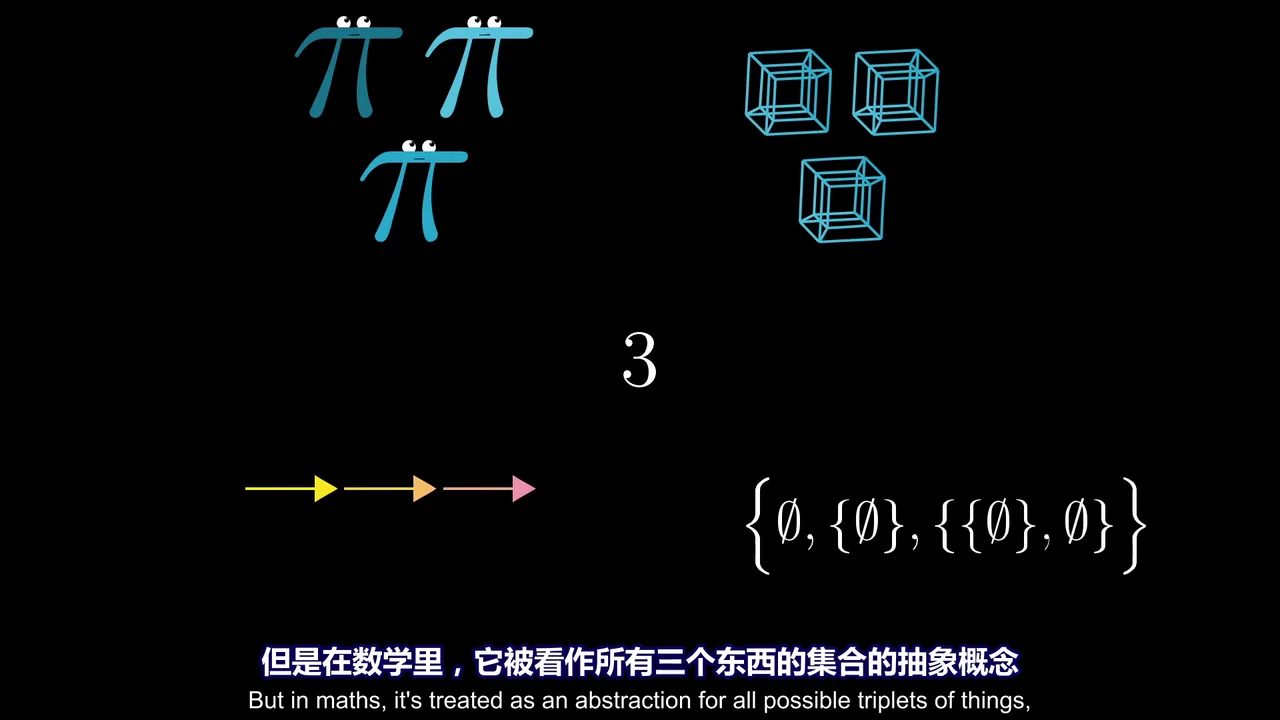
因此,数学家对“向量究竟是什么”的回答是——直接忽略这个问题!这就像追问“数字 $3$ 究竟是什么”一样:具体场景中它可能是三只猫、三个苹果或三个音符,而在数学里,$3$ 是对天下所有“三元组”提取出来的纯粹抽象概念;同理,向量空间也是对世间一切具备线性结构的具体对象提炼出的无形抽象。
💡 《线性代数的本质》全系列结语:先有直觉,后懂抽象
先在二维/三维原点箭头这种具体、可视的舞台上建立牢不可破的几何直觉,再在需要追求普适性时明白教科书为何采用抽象公理表达。看完本系列并不等同于学完整个线性代数——真正的掌控感必须来自亲自动手解题——但只要这些核心几何直觉已深植于你的脑海,你未来的每一步学习都将事半功倍、清晰通透。
绝妙类比:抽象数字“3”不等于三颗苹果也不等于三个音符,而是所有三元组的抽象本质 14:52
绝妙类比:抽象数字“3”不等于三颗苹果也不等于三个音符,而是所有三元组的抽象本质画面重点:以数字 3 类比“抽象向量空间”的哲学意涵
Grant 总结:抽象固然重要,但仍推荐从二维具体几何出发建立直观思维,以此结束全系列之旅 15:14
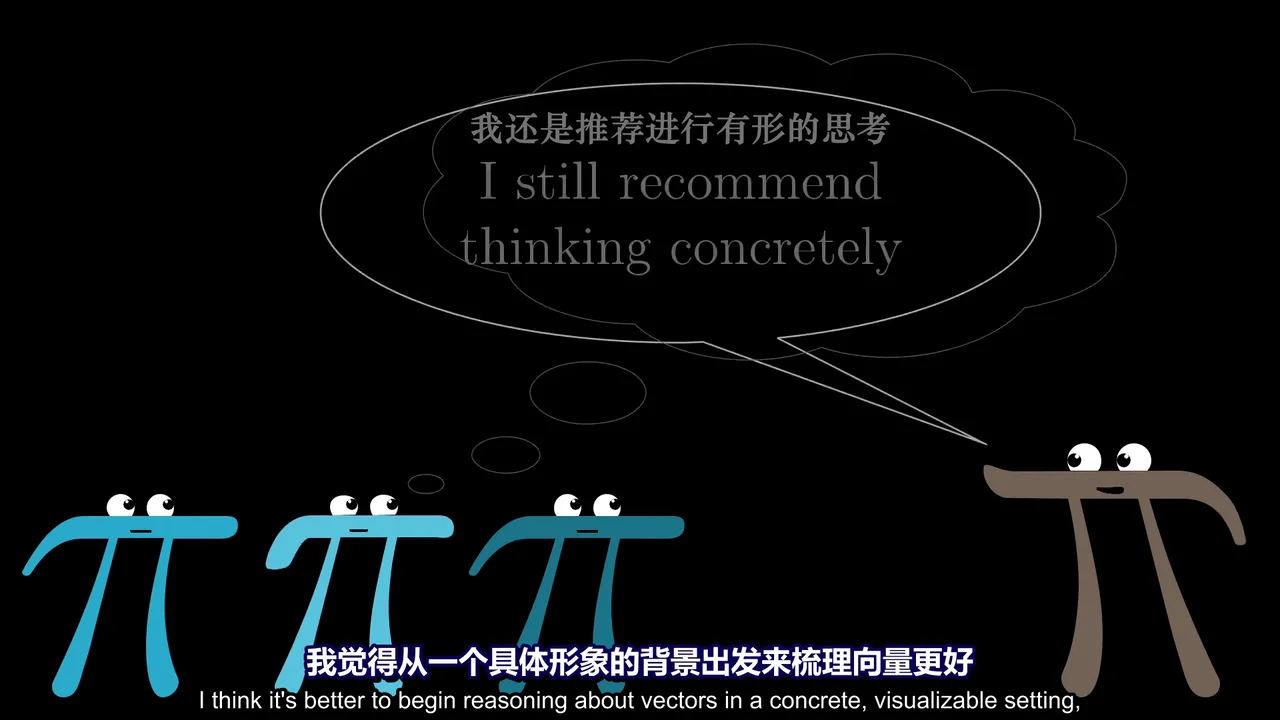
Grant 总结:抽象固然重要,但仍推荐从二维具体几何出发建立直观思维,以此结束全系列之旅画面重点:全系列大结局思想收束
[14:23] ↗
所以对于“向量是什么”这个问题,数学家会直接忽略不作答
So the mathematician's answer to what are vectors is to just ignore the question.
[14:28] ↗
在现代理论中 向量的形式并不重要,箭头、一组数、函数、π生物等等都无所谓
In the modern theory, the form that vectors take doesn't really matter.
[14:32] ↗
它可以是任何东西 只要向量相加和数乘的概念遵守以上规则即可
Arrows, lists of numbers, functions, pi creatures, really, it can be anything, so long as there's some notion of adding and scaling vectors that follows these rules.
[14:42] ↗
这就像是在问“3”究竟是什么一样
It's like asking what the number 3 really is.
[14:45] ↗
遇到具体情况时,它就代表着三个东西的集合 但是在数学里,它被看作所有三个东西的集合的抽象概念 从而让你用一个概念就能推出所有三个东西的集合
Whenever it comes up concretely, it's in the context of some triplet of things, but in math, it's treated as an abstraction for all possible triplets of things, and lets you reason about all possible triplets using a single idea.
[14:59] ↗
向量也是如此,它有很多种体现 但是数学把它抽象成“向量空间”这样一个无形的概念
Same goes with vectors, which have many embodiments, but math abstracts them all into a single, intangible notion of a vector space.
[15:09] ↗
看过这个系列的人都知道 我觉得从一个具体形象的背景出发来梳理向量更好 比如二维空间中以原点为起点的箭头
But, as anyone watching this series knows, I think it's better to begin reasoning about vectors in a concrete, visualizable setting, like 2D space, with arrows rooted at the origin.
[15:20] ↗
但是你学到了更多线性代数知识,知道了这些概念有更广泛的应用 这就是教科书中和课堂上更倾向于抽象表述的根本原因
But as you learn more linear algebra, know that these tools apply much more generally, and that this is the underlying reason why textbooks and lectures tend to be phrased, well, abstractly.
[15:32] ↗
以上就是“线性代数的本质”系列的最后一部分内容
So with that, folks, I think I'll call it an in to this essence of linear algebra series.
[15:36] ↗
如果你看过并且理解了这些视频 我相信你已经对线性代数的潜在直观有了深厚的理解
If you've watched and understood the videos, I really do believe that you have a solid foundation in the underlying intuitions of linear algebra.
[15:45] ↗
当然,这和你学习完整的课程不是一回事 因为学习过程真的只能来源于解决问题 但是如果你具备了正确的直观,你会在以后的学习中更加高效
This is not the same thing as learning the full topic, of course, that's something that can only really come from working through problems, but the learning you do moving forward could be substantially more efficient if you have all the right intuitions in place.
[15:57] ↗
愿你能在运用直观思维时找到乐趣,同时也祝你今后的学习顺利
So, have fun applying those intuitions, and best of luck with your future learning.

📝 几何直觉自测(点击题目展开解答)

Q1. 求导算子 $\frac{d}{dx}$ 满足哪些条件,才使我们可以把它视为一个“线性变换”并用矩阵表示?▼
它同时满足可加性 $\frac{d}{dx}(f+g) = \frac{df}{dx}+\frac{dg}{dx}$ 与齐次性/成比例性 $\frac{d}{dx}(cf) = c\frac{df}{dx}$。选取多项式幂基 $1, x, x^2, \dots$ 后,每列放入对应基函数的导数坐标即可写成无限阶求导矩阵。
Q2. 如果以幂基 $\{1, x, x^2, x^3, \dots\}$ 作为坐标系,请问函数 $e^{2x}$ 在全体光滑函数空间中针对求导算子 $\frac{d}{dx}$ 扮演什么角色?▼
因为 $\frac{d}{dx}(e^{2x}) = 2e^{2x}$,求导算子对它而言仅仅相当于乘以标量 $2$。所以 $e^{2x}$ 是求导算子的一个特征函数(eigenfunction),对应的特征值为 $\lambda = 2$!
Q3. 为什么现代线性代数教材往往从“八条抽象公理”出发,而不是一开始就把向量定义为平面箭头或坐标数组?▼
这八条公理相当于“理论定理”与“万物应用”之间的标准接口。一旦定理只由这八条公理推导出来,那么无论是三维箭头、高维数组、多项式、微分方程解空间还是量子态向量空间,只要验证满足这八条规则,就能无条件套用全部线性代数结论。